
There is no universal winner in nylon vs polyester. Choose nylon fabric when abrasion resistance, toughness, stretch, or repeated flex matters most. Choose polyester fabric when UV exposure, lower water absorption, faster drying, dimensional stability, print compatibility, or cost control matters most. For waterproof or heavy-duty projects, compare denier, weave, coating, finish, seams, and end use before choosing by fiber alone.
For fabric buyers, the better question is not simply “nylon or polyester?” The better question is: what failure mode does the finished fabric need to resist? A backpack panel, outdoor cover, printed banner, tent fly, marine cover, bag lining, and industrial sack can point to different material choices even when the comparison starts with the same two fibers.
![There is no universal winner in nylon vs polyester. Choose nylon fabric when abrasion resistance, toughness, stretch, or repeated flex matters most. Choose polyester fabric when UV exposure, lower water absorption, faster drying, dimensional stability, print compatibility, or cost control matters most. For waterproof or heavy-duty projects, compare denier, weave, coating, finish, seams, and end use before choosing by fiber alone.
For fabric buyers, the better question is not simply “nylon or polyester?” The better question is: what failure mode does the finished fabric need to resist? A backpack panel, outdoor cover, printed banner, tent fly, marine cover, bag lining, and industrial sack can point to different material choices even when the comparison starts with the same two fibers.
Nylon vs Polyester: Quick Decision Box
Use this quick decision box as a starting point, then verify the final fabric by specification, swatch, coating, and end-use requirements.
If your top requirement is... Start with... Why this direction usually fits
Abrasion resistance Nylon Nylon is commonly selected for rubbing, flexing, straps, gear, and high-wear surfaces. Canvas ETC’s denier guide identifies nylon as the stronger starting point for abrasion and tear-resistance priorities, while still warning that material, weave, tenacity, and coating modify final performance.
Stretch or shock absorption Nylon Nylon generally has more give than polyester, which can help where flex or impact movement matters. Verify this against the exact fabric construction before production.
UV exposure Polyester Polyester is usually the stronger starting point for prolonged sun exposure. Canvas ETC’s denier guide identifies polyester as a better fit for UV resistance, low water absorption, and dimensional stability when wet.
Lower water absorption Polyester Polyester generally absorbs less moisture than nylon and usually dries faster. Canvas ETC’s denier guide gives polyester a lower water-absorption profile than nylon in its nylon/polyester comparison.
Waterproofness Coated nylon or coated polyester Waterproofness depends on coating, lamination, seams, and construction, not fiber alone. Canvas ETC’s coating guide distinguishes PU, PVC, and DWR finishes and notes that DWR is water-repellent, not waterproof.
Printed banners or display graphics Polyester or coated polyester Polyester is often a practical starting point for print-focused applications. For deeper print-method context, see Canvas ETC’s guide to printed cotton fabric dye sublimation vs screen printing and large-format fabric printing.
Heavy-duty outdoor covers Coated polyester Coated polyester often fits projects where UV exposure, moisture, dimensional stability, and coating performance matter together. Review Canvas ETC’s denier fabric coatings guide before selecting a coated fabric.
High-wear gear or luggage High-denier nylon or ballistic nylon Nylon is often chosen where abrasion, toughness, and flex are primary requirements. For heavy-wear applications, compare 1000 denier nylon and 1050 denier ballistic nylon.
Specification rule: Do not choose a fabric by fiber name alone. Denier, weave, yarn quality, coating, finish, backing, seam design, and exposure conditions can change how nylon and polyester perform in the finished product.
Nylon vs Polyester Comparison Matrix
Nylon and polyester differ most clearly by abrasion behavior, stretch, water behavior, UV exposure, dimensional stability, print compatibility, cost tendency, and finished-fabric construction. This matrix compares the two materials as fabric-selection starting points, not as absolute winners.
Comparison dimension Nylon fabric Polyester fabric Selection guidance
Fiber class Manufactured synthetic polyamide fiber Manufactured synthetic ester-based fiber Use fiber class for identification, then verify fabric construction. Federal textile rules define polyester as an ester-based manufactured fiber and nylon as a synthetic polyamide manufactured fiber.
Abrasion resistance Usually the stronger starting point for high-rub use Can be durable, but is often selected for other outdoor or print-related priorities Choose nylon when rubbing, dragging, flexing, or load-bearing contact is the main concern.
Stretch and recovery Generally more elastic Generally more dimensionally stable Choose nylon when flex matters; choose polyester when shape retention matters.
Water absorption Generally absorbs more moisture than polyester Generally absorbs less moisture and usually dries faster Choose polyester for wet environments unless a specific coated nylon meets the project requirement.
UV exposure Often needs UV protection or suitable finishing for long sun exposure Usually the better starting point for UV-exposed fabric Choose polyester for covers, awnings, banners, and sun-exposed outdoor uses.
Waterproofness Not waterproof by fiber alone Not waterproof by fiber alone Verify coating, lamination, hydrostatic performance, seams, and intended exposure.
Heat and care Can be more heat-sensitive depending on construction and finish Often more stable for some heat and print workflows Verify care, finishing, and print-process requirements before production.
Printing and color Can work with suitable dye or print systems Often preferred for many print and display applications Match the fabric to the printing method, coating, color target, and heat exposure.
Cost tendency Often higher, depending on denier and finish Often lower-cost in common commodity forms Verify current pricing before estimating a project.
Sustainability Synthetic material; recycling pathway varies Synthetic material; recycled PET pathways may be more available in some markets Avoid broad sustainability claims without current source support. Textile Exchange reporting covered by Vogue Business notes that polyester dominates global fiber production by volume, but the same reporting cautions that substitution alone does not solve material-impact issues.
Final performance Depends on denier, weave, yarn quality, coating, finish, and construction Depends on denier, weave, yarn quality, coating, finish, and construction The finished fabric system matters more than the fiber label alone.
Choose Nylon or Polyester by Project Type
Choose the fabric by the project requirement that cannot fail. If abrasion is the main risk, nylon is often the better starting point. If sunlight, moisture, print stability, or dimensional stability is the main risk, polyester is often the better starting point.
Project or product Better starting point Why this direction fits Specification to verify
Backpacks and gear bags nylon packcloth, 420D nylon fabric, or 420D nylon pack cloth Bags often fail through abrasion, rubbing, flexing, and load stress. Denier, weave, abrasion data, tear strength, coating, and sewing compatibility.
Straps, handles, and reinforcement panels 1000 denier nylon or 1000D nylon fabric These parts often face pulling, bending, and repeated contact. Tensile strength, abrasion resistance, elongation, stitch performance, and edge finishing.
Outdoor covers 600 denier polyester or 600 denier polyester woodland camo Covers often need UV resistance, lower water absorption, and dimensional stability. Coating type, waterproofness, UV resistance, width, weight, and mildew-resistance claims if used.
Awnings and marine covers 18 oz vinyl-coated polyester fabric or 18 oz vinyl polyester Outdoor exposure often prioritizes UV, moisture, coating durability, and shape retention. Coating, UV protection, water resistance, cleaning method, and seam construction.
Printed banners and display fabric 600 denier polyester or vinyl-coated polyester Display fabric often prioritizes print compatibility, dimensional stability, opacity, and color behavior. Print process, coating, surface finish, heat tolerance, opacity, and roll width.
Lightweight tents and tarps 70 denier nylon ripstop or 70D black ripstop nylon Nylon may help with low weight and tear control; polyester may help with UV and wet stability. Denier, ripstop grid, coating, waterproof rating, packed weight, and seam sealing.
Apparel linings or flexible fabric parts 210 denier nylon or polyester, depending on hand and use Nylon may provide flexibility and softness; polyester may provide faster drying and stability. Hand feel, drape, breathability, lining use, care, and dye or print method.
Industrial bags and sacks High-denier nylon, 600D polyester, or coated polyester Nylon favors abrasion and flex; polyester favors UV, moisture, and cost-sensitive scale. Load, abrasion, UV exposure, coating, cleaning method, and replacement cycle. For broader material selection, see best fabric for industrial bags and sacks.
Mesh or ventilation panels polyester mesh fabric, poly mesh fabric, or vinyl-coated mesh Mesh selection depends on airflow, tear risk, stretch, coating, and exposure. Mesh opening, yarn size, coating, UV exposure, and load requirements.
What Nylon and Polyester Are
Nylon and polyester are both synthetic textile fibers, but they are not the same material. Nylon is a synthetic polyamide fiber, while polyester is an ester-based synthetic fiber. U.S. textile fiber rules define polyester as a manufactured fiber formed from long-chain synthetic polymers with ester units, and nylon as a manufactured fiber formed from long-chain synthetic polyamide. ([eCFR][3])
What is nylon fabric?
Nylon fabric is made from nylon/polyamide fibers that can be woven, knitted, coated, laminated, or finished for different applications. In fabric selection, nylon is commonly associated with toughness, abrasion resistance, flexibility, and gear-oriented uses.
Common nylon fabric pathways include nylon packcloth, ripstop nylon, 1000 denier nylon, and 1050 denier ballistic nylon. These fabrics should not be treated as interchangeable. A lightweight ripstop nylon and a high-denier ballistic nylon can share a fiber family while serving very different project requirements.
What is polyester fabric?
Polyester fabric is made from polyester fibers and can be woven, knitted, coated, printed, or finished for many applications. In fabric selection, polyester is commonly associated with lower moisture absorption, faster drying, dimensional stability, UV exposure, and print-focused uses.
Common polyester fabric pathways include 600 denier polyester, polyester mesh, vinyl-coated polyester mesh, and 18 oz vinyl-coated polyester. These fabrics should be evaluated by denier, coating, finish, width, weight, and intended exposure.
Strength, Abrasion, and Stretch
Nylon is usually the better starting point when abrasion resistance, toughness, stretch, and repeated flex are the main requirements. Canvas ETC’s denier guidance identifies nylon as a strong fit for abrasion and tear resistance, while also explaining that final fabric performance depends on material type, weave, yarn quality, and coatings.
That recommendation still needs a specification check. Abrasion resistance is affected by fiber type, denier, weave, yarn quality, finish, coating, and how the fabric contacts other surfaces. A high-denier nylon may be suitable for one abrasion-heavy project, while a coated polyester may be more suitable for another project where abrasion is secondary to water and UV exposure.
For publication, avoid fixed abrasion-cycle numbers unless the article includes the fabric construction, test method, source, and scope. Use this safer claim structure: nylon is usually the better starting point for abrasion-prone fabric applications, but final selection should be verified with fabric specifications, physical samples, or abrasion-test data.
For abrasion-heavy projects, review 1000 denier nylon, 1050 denier ballistic nylon, and Canvas ETC’s guide to what ballistic nylon is made of. Canvas ETC describes ballistic nylon as a high-tenacity nylon fabric with basketweave construction used for luggage, tool belts, and motorcycle gear applications.
Water, Drying, UV, and Outdoor Exposure
Polyester is usually the better starting point for wet and sunny environments, but waterproof performance depends on the complete fabric system. Canvas ETC’s denier guide identifies polyester as a better fit for UV resistance, low water absorption, and dimensional stability when wet.
For outdoor use, polyester is often selected when the project prioritizes UV exposure, color stability, moisture behavior, and dimensional stability. Nylon can still work outdoors when the project prioritizes flex, low weight, abrasion, or a specific coated construction. The decision should follow the exposure condition, not a generic “outdoor fabric” label.
Water-resistant is not the same as waterproof
Water-resistant fabric can slow water penetration, shed light moisture, or resist brief exposure. Waterproof fabric requires a coating, lamination, membrane, seam strategy, or construction method that blocks water under the intended pressure and duration.
A DWR finish can help water bead on the surface, but DWR is not the same as waterproof construction. Canvas ETC’s coating guide explains that PU and PVC coatings can add water resistance or waterproofness, while DWR is a surface repellency finish that wears down over time.
For covers, tarps, awnings, marine uses, and outdoor storage, evaluate the full fabric system: base fiber, denier, weave, coating, seam design, UV exposure, cleaning method, and expected service life. For deeper project context, see best marine canvas material, marine fabric uses, and RV awning and upholstery fabrics.
Why Denier, Weave, and Coating Can Change the Answer
Denier, weave, and coating can change the answer to nylon vs polyester because they modify how the finished fabric handles weight, abrasion, tear behavior, water, stiffness, and long-term durability. Canvas ETC defines denier as yarn linear mass density and emphasizes that material, weave, yarn quality, and coatings modify final performance.
For a deeper explanation, see Canvas ETC’s guide on how to choose denier fabric.
Denier changes yarn size and durability potential
Higher denier usually means thicker, heavier yarns. Thicker yarns can increase durability potential, but denier alone does not prove that a finished fabric will resist abrasion, tearing, UV exposure, or water penetration.
A lightweight 70D ripstop nylon can be useful where packed weight and tear control matter. A 420D nylon fabric can be useful for bags and gear. A 1000D nylon can be useful for high-wear applications. A 600D polyester can be useful for covers, banners, and outdoor applications when UV exposure, moisture behavior, printability, or dimensional stability matter.
Weave changes tear behavior and surface performance
Weave structure changes how yarns interact under stress. Canvas ETC’s weave guide explains that weave structure affects texture, tensile strength, tear strength, drape, breathability, and overall durability.
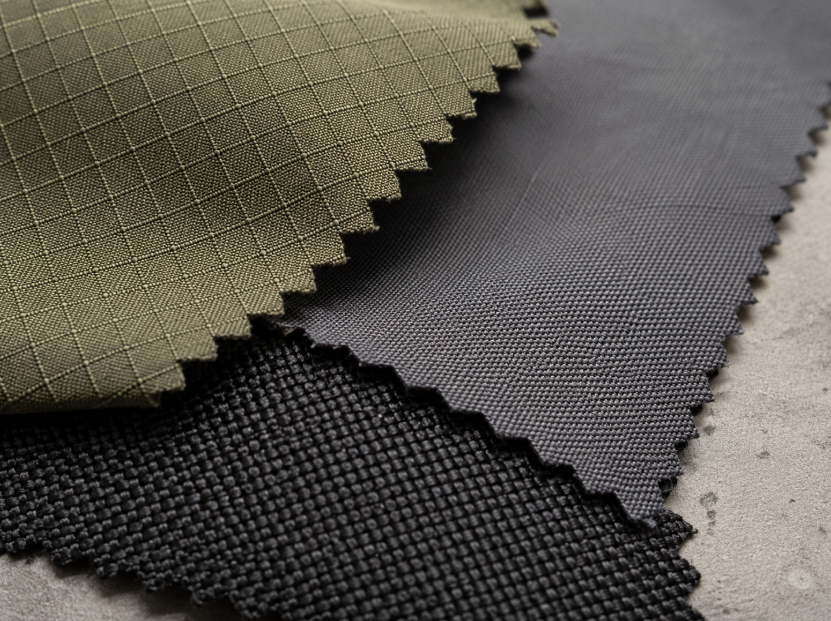
A ripstop weave helps limit tear spread by reinforcing the fabric grid, while a dense ballistic-style construction is used where toughness and abrasion resistance are priorities. Plain, oxford, ripstop, and ballistic constructions should not be treated as interchangeable just because the fiber is nylon or polyester.
For more detail, see denier fabric weave types: plain vs oxford vs ripstop.
Coating changes water resistance, stiffness, and handling
Coatings can matter more than base fiber when the target requirement is waterproofness. PU coatings, PVC coatings, vinyl coatings, laminates, and DWR finishes modify the base fabric in different ways. Canvas ETC’s coating guide explains that these treatments modify base fabrics by adding water resistance, durability, flexibility, or repellency, and it distinguishes DWR from waterproof construction.
For a waterproof outdoor cover, a coated polyester may be a better starting point than an uncoated nylon. For a flexible high-wear bag panel, a high-denier nylon may be a better starting point than a stiff coated material. The correct decision follows the project requirement.
For more detail, see denier fabric coatings and water-resistant fabric meaning.
Printing, Color, Heat, and Care
Polyester is often the better starting point for print-focused and color-stable applications, while nylon may be better when flexibility, hand, or high-wear performance matters more. The printing method, dye system, coating, finish, heat exposure, and end use should be verified before production.
For dye sublimation and many display applications, polyester is commonly used because the printing process often aligns with polyester chemistry and heat transfer requirements. For coated banners, display graphics, and event materials, polyester or vinyl-coated polyester may be more appropriate than nylon.
For deeper print-method context, use these Canvas ETC resources:
printed cotton fabric: dye sublimation vs screen printing
large-format fabric printing
how to print on canvas fabric
digital fabric printing
the advantages of digital fabric printing
Care instructions should follow the finished fabric, not just the fiber name. Coated fabrics, printed fabrics, flame-retardant fabrics, mesh fabrics, and heavy denier fabrics can have different cleaning, heat, drying, and storage requirements. Do not apply generic apparel laundry guidance to coated industrial fabric, marine fabric, display fabric, or technical denier fabric without checking the product specification.
Sustainability and Microfiber Considerations
Neither nylon nor polyester is automatically sustainable. Both are synthetic materials, and environmental impact depends on feedstock, manufacturing, durability, recycled content, laundering behavior, repairability, useful life, and end-of-life pathway.
Polyester may have more widely available recycled PET pathways in some markets, while recycled nylon availability depends on source material, supplier, and product type. Textile Exchange reporting covered by Vogue Business states that global fiber production reached 132 million tonnes in 2024 and that polyester represented 59% of fiber production, underscoring why polyester-related sourcing and recycling claims need careful sourcing rather than broad “eco-friendly” language.
For buyers, the practical sustainability question is not “Which synthetic fiber is good?” The practical question is: which fabric will perform correctly, last long enough, avoid premature replacement, and fit an available reuse, repair, recycling, or disposal pathway?
Related Canvas ETC reading:
organic cotton canvas
recycled cotton canvas fabric
sustainable canvas duck fabric
canvas fabric material composition
Canvas ETC Fabric Starting Points
Canvas ETC fabric options should be treated as starting points for specification review, not universal recommendations. The right fabric depends on denier, width, coating, color, finish, weave, order quantity, and end use.
If you need... Canvas ETC starting point to review Why it may fit Validate before ordering
Bag lining, midweight gear, or packcloth nylon packcloth, 420D nylon fabric, or 420D nylon pack cloth Useful where flexibility and abrasion resistance matter. Width, color, weight, finish, and availability.
Heavy-wear gear, luggage, or reinforcement 1000D nylon or 1050D ballistic nylon Useful where toughness and abrasion are major concerns. Denier, weave, finish, color, and product status.
Lightweight tear control 70D nylon ripstop or 70D black ripstop nylon Useful where low weight and tear control matter. Denier, coating, width, color, and intended use.
Outdoor covers, displays, or banners 600D polyester or 600D polyester woodland camo Useful where UV, moisture, printability, or dimensional stability matter. Coating, width, finish, color, and print compatibility.
Waterproof or heavy-duty barriers 18 oz vinyl-coated polyester, 18 oz vinyl polyester black, or 18 oz vinyl-coated polyester royal blue Useful where coating performance is central. Coating type, weight, width, and waterproof/water-resistant claims.
Ventilation or mesh applications polyester mesh fabric, poly mesh fabric, or vinyl-coated polyester mesh Useful where airflow, openness, or coated mesh behavior is needed. Mesh opening, coating, width, and load requirements.
Before production, review the live product page and order printed fabric swatches/samples when the project depends on hand feel, stiffness, color, coating feel, print behavior, or sewing performance.
How to Verify the Right Fabric Before Ordering
Verify nylon or polyester fabric by matching the project requirement to the fabric specification. The safest selection workflow is to define the failure risk first, then compare fiber, denier, weave, coating, width, finish, and sample behavior.
Define the main failure risk. Decide whether the fabric is most likely to fail from abrasion, UV exposure, water, tearing, stretching, load, color shift, print failure, or cleaning conditions.
Choose the starting fiber. Use nylon for abrasion, flex, and high-wear priorities. Use polyester for UV exposure, lower water absorption, dimensional stability, and many print-focused priorities.
Check denier and weave. Confirm that yarn size and construction match the expected weight, tear behavior, and durability needs. Start with how to choose denier fabric and denier fabric types.
Check coating or finish. For water resistance or waterproofness, verify coating, lamination, DWR, backing, seam strategy, and any stated water-performance rating. Use denier fabric coatings as the next-step guide.
Review product specifications. Confirm width, weight, color, coating, finish, minimum order, and intended use on the current product page.
Order or inspect a swatch. Use a physical sample to evaluate hand feel, stiffness, color, texture, coating feel, opacity, and sewing behavior.
Validate production requirements. For printing, outdoor use, marine use, or industrial use, confirm the fabric with the production method and exposure conditions before ordering full yardage or rolls.
This workflow turns the polyester vs nylon comparison into a fabric-selection process instead of a generic material preference.FAQs About Nylon vs Polyester
Which is stronger, nylon or polyester?
Nylon is usually the stronger starting point when the requirement is abrasion resistance, toughness, or stretch. Polyester can still be durable, especially in higher deniers or coated constructions, but nylon is often selected for high-wear gear, straps, luggage, and reinforcement panels. Canvas ETC’s denier guide identifies nylon as stronger for abrasion and tear-resistance priorities while emphasizing that denier, weave, and coatings modify final performance.
Which is more waterproof, nylon or polyester?
Neither nylon nor polyester is waterproof by fiber alone. Polyester generally absorbs less water than nylon, but waterproof fabric requires a coating, lamination, membrane, seam strategy, or construction method that blocks water under the intended pressure and duration. Canvas ETC’s coating guide distinguishes DWR surface repellency from waterproof coating systems.
Which dries faster, nylon or polyester?
Polyester usually dries faster because polyester generally absorbs less moisture than nylon. Finished-fabric drying behavior can still change with weave, coating, fabric weight, lining, backing, and finish. Canvas ETC’s denier guide describes polyester as having lower water absorption than nylon and better dimensional stability when wet.
Which is better for outdoor use?
Polyester is usually the better starting point for prolonged outdoor exposure because outdoor fabric often needs UV resistance, lower water absorption, and dimensional stability. Nylon may still fit outdoor applications when abrasion, flex, low weight, or a specific coated construction is more important.
Which is better for bags?
Nylon is often the better starting point for bags that need abrasion resistance, flex, and high-wear durability. Polyester can be the better starting point for bags or covers that need UV exposure resistance, lower water absorption, printability, or cost-sensitive production. For bag-specific material planning, see Canvas ETC’s guide to the best fabric for bag linings and best fabric for industrial bags and sacks.
Which is better for tents?
Nylon or polyester can work for tents depending on the design priority. Ripstop nylon is often useful where low weight and tear control matter, while polyester can be useful where UV exposure and wet dimensional stability matter. Coating and seam construction are critical for rain performance. For tent-related buying guidance, see a helpful quick guide to buying tent fabrics and tent canvas fabric projects.
Which is better for printing?
Polyester is often the better starting point for print-focused fabric, especially where the print method is designed for polyester or coated polyester. Before production, verify the print process, coating, finish, heat settings, color target, and fabric width. For print-method context, see printed cotton fabric dye sublimation vs screen printing and large-format fabric printing.
Does denier matter more than nylon or polyester?
Denier can matter as much as the fiber choice because denier affects yarn size, weight, and durability potential. Denier does not decide performance alone, so compare denier with fiber type, weave, coating, finish, and intended use. Canvas ETC’s denier guide specifically warns not to choose based on denier alone.
Is nylon or polyester more sustainable?
Neither nylon nor polyester is inherently sustainable. Sustainability depends on feedstock, recycled content, manufacturing, durability, laundering, microfiber shedding, repairability, reuse, and end-of-life pathway. Use current sustainability evidence before making any broad environmental claim.
Final Selection Rule
Choose nylon when the project is most likely to fail from abrasion, stretching, pulling, flexing, or repeated high-wear contact. Choose polyester when the project is most likely to fail from sun exposure, moisture, shape distortion, print instability, or cost constraints. Choose a coated or laminated fabric when the project requires waterproofness, because waterproof performance depends on the full fabric system rather than the fiber name alone.](https://www.canvasetc.com/wp-content/uploads/2019/06/Side-by-side-nylon-and-polyester-fabric-swatches-showing-texture-differences-for-fabric-selection.png)
Use this quick decision box as a starting point, then verify the final fabric by specification, swatch, coating, and end-use requirements.
| If your top requirement is… | Start with… | Why this direction usually fits |
|---|---|---|
| Abrasion resistance | Nylon | Nylon is commonly selected for rubbing, flexing, straps, gear, and high-wear surfaces. Canvas ETC’s denier guide identifies nylon as the stronger starting point for abrasion and tear-resistance priorities, while still warning that material, weave, tenacity, and coating modify final performance. |
| Stretch or shock absorption | Nylon | Nylon generally has more give than polyester, which can help where flex or impact movement matters. Verify this against the exact fabric construction before production. |
| UV exposure | Polyester | Polyester is usually the stronger starting point for prolonged sun exposure. Canvas ETC’s denier guide identifies polyester as a better fit for UV resistance, low water absorption, and dimensional stability when wet. |
| Lower water absorption | Polyester | Polyester generally absorbs less moisture than nylon and usually dries faster. Canvas ETC’s denier guide gives polyester a lower water-absorption profile than nylon in its nylon/polyester comparison. |
| Waterproofness | Coated nylon or coated polyester | Waterproofness depends on coating, lamination, seams, and construction, not fiber alone. Canvas ETC’s coating guide distinguishes PU, PVC, and DWR finishes and notes that DWR is water-repellent, not waterproof. |
| Printed banners or display graphics | Polyester or coated polyester | Polyester is often a practical starting point for print-focused applications. For deeper print-method context, see Canvas ETC’s guide to printed cotton fabric dye sublimation vs screen printing and large-format fabric printing. |
| Heavy-duty outdoor covers | Coated polyester | Coated polyester often fits projects where UV exposure, moisture, dimensional stability, and coating performance matter together. Review Canvas ETC’s denier fabric coatings guide before selecting a coated fabric. |
| High-wear gear or luggage | High-denier nylon or ballistic nylon | Nylon is often chosen where abrasion, toughness, and flex are primary requirements. For heavy-wear applications, compare 1000 denier nylon and 1050 denier ballistic nylon. |
Specification rule: Do not choose a fabric by fiber name alone. Denier, weave, yarn quality, coating, finish, backing, seam design, and exposure conditions can change how nylon and polyester perform in the finished product.
Nylon and polyester differ most clearly by abrasion behavior, stretch, water behavior, UV exposure, dimensional stability, print compatibility, cost tendency, and finished-fabric construction. This matrix compares the two materials as fabric-selection starting points, not as absolute winners.
| Comparison dimension | Nylon fabric | Polyester fabric | Selection guidance |
|---|---|---|---|
| Fiber class | Manufactured synthetic polyamide fiber | Manufactured synthetic ester-based fiber | Use fiber class for identification, then verify fabric construction. Federal textile rules define polyester as an ester-based manufactured fiber and nylon as a synthetic polyamide manufactured fiber. |
| Abrasion resistance | Usually the stronger starting point for high-rub use | Can be durable, but is often selected for other outdoor or print-related priorities | Choose nylon when rubbing, dragging, flexing, or load-bearing contact is the main concern. |
| Stretch and recovery | Generally more elastic | Generally more dimensionally stable | Choose nylon when flex matters; choose polyester when shape retention matters. |
| Water absorption | Generally absorbs more moisture than polyester | Generally absorbs less moisture and usually dries faster | Choose polyester for wet environments unless a specific coated nylon meets the project requirement. |
| UV exposure | Often needs UV protection or suitable finishing for long sun exposure | Usually the better starting point for UV-exposed fabric | Choose polyester for covers, awnings, banners, and sun-exposed outdoor uses. |
| Waterproofness | Not waterproof by fiber alone | Not waterproof by fiber alone | Verify coating, lamination, hydrostatic performance, seams, and intended exposure. |
| Heat and care | Can be more heat-sensitive depending on construction and finish | Often more stable for some heat and print workflows | Verify care, finishing, and print-process requirements before production. |
| Printing and color | Can work with suitable dye or print systems | Often preferred for many print and display applications | Match the fabric to the printing method, coating, color target, and heat exposure. |
| Cost tendency | Often higher, depending on denier and finish | Often lower-cost in common commodity forms | Verify current pricing before estimating a project. |
| Sustainability | Synthetic material; recycling pathway varies | Synthetic material; recycled PET pathways may be more available in some markets | Avoid broad sustainability claims without current source support. Textile Exchange reporting covered by Vogue Business notes that polyester dominates global fiber production by volume, but the same reporting cautions that substitution alone does not solve material-impact issues. |
| Final performance | Depends on denier, weave, yarn quality, coating, finish, and construction | Depends on denier, weave, yarn quality, coating, finish, and construction | The finished fabric system matters more than the fiber label alone. |
Choose the fabric by the project requirement that cannot fail. If abrasion is the main risk, nylon is often the better starting point. If sunlight, moisture, print stability, or dimensional stability is the main risk, polyester is often the better starting point.
| Project or product | Better starting point | Why this direction fits | Specification to verify |
|---|---|---|---|
| Backpacks and gear bags | nylon packcloth, 420D nylon fabric, or 420D nylon pack cloth | Bags often fail through abrasion, rubbing, flexing, and load stress. | Denier, weave, abrasion data, tear strength, coating, and sewing compatibility. |
| Straps, handles, and reinforcement panels | 1000 denier nylon or 1000D nylon fabric | These parts often face pulling, bending, and repeated contact. | Tensile strength, abrasion resistance, elongation, stitch performance, and edge finishing. |
| Outdoor covers | 600 denier polyester or 600 denier polyester woodland camo | Covers often need UV resistance, lower water absorption, and dimensional stability. | Coating type, waterproofness, UV resistance, width, weight, and mildew-resistance claims if used. |
| Awnings and marine covers | 18 oz vinyl-coated polyester fabric or 18 oz vinyl polyester | Outdoor exposure often prioritizes UV, moisture, coating durability, and shape retention. | Coating, UV protection, water resistance, cleaning method, and seam construction. |
| Printed banners and display fabric | 600 denier polyester or vinyl-coated polyester | Display fabric often prioritizes print compatibility, dimensional stability, opacity, and color behavior. | Print process, coating, surface finish, heat tolerance, opacity, and roll width. |
| Lightweight tents and tarps | 70 denier nylon ripstop or 70D black ripstop nylon | Nylon may help with low weight and tear control; polyester may help with UV and wet stability. | Denier, ripstop grid, coating, waterproof rating, packed weight, and seam sealing. |
| Apparel linings or flexible fabric parts | 210 denier nylon or polyester, depending on hand and use | Nylon may provide flexibility and softness; polyester may provide faster drying and stability. | Hand feel, drape, breathability, lining use, care, and dye or print method. |
| Industrial bags and sacks | High-denier nylon, 600D polyester, or coated polyester | Nylon favors abrasion and flex; polyester favors UV, moisture, and cost-sensitive scale. | Load, abrasion, UV exposure, coating, cleaning method, and replacement cycle. For broader material selection, see best fabric for industrial bags and sacks. |
| Mesh or ventilation panels | polyester mesh fabric, poly mesh fabric, or vinyl-coated mesh | Mesh selection depends on airflow, tear risk, stretch, coating, and exposure. | Mesh opening, yarn size, coating, UV exposure, and load requirements. |
Nylon and polyester are both synthetic textile fibers, but they are not the same material. Nylon is a synthetic polyamide fiber, while polyester is an ester-based synthetic fiber. U.S. textile fiber rules define polyester as a manufactured fiber formed from long-chain synthetic polymers with ester units, and nylon as a manufactured fiber formed from long-chain synthetic polyamide. ([eCFR][3])
Nylon fabric is made from nylon/polyamide fibers that can be woven, knitted, coated, laminated, or finished for different applications. In fabric selection, nylon is commonly associated with toughness, abrasion resistance, flexibility, and gear-oriented uses.
Common nylon fabric pathways include nylon packcloth, ripstop nylon, 1000 denier nylon, and 1050 denier ballistic nylon. These fabrics should not be treated as interchangeable. A lightweight ripstop nylon and a high-denier ballistic nylon can share a fiber family while serving very different project requirements.
Polyester fabric is made from polyester fibers and can be woven, knitted, coated, printed, or finished for many applications. In fabric selection, polyester is commonly associated with lower moisture absorption, faster drying, dimensional stability, UV exposure, and print-focused uses.
Common polyester fabric pathways include 600 denier polyester, polyester mesh, vinyl-coated polyester mesh, and 18 oz vinyl-coated polyester. These fabrics should be evaluated by denier, coating, finish, width, weight, and intended exposure.
Nylon is usually the better starting point when abrasion resistance, toughness, stretch, and repeated flex are the main requirements. Canvas ETC’s denier guidance identifies nylon as a strong fit for abrasion and tear resistance, while also explaining that final fabric performance depends on material type, weave, yarn quality, and coatings.
That recommendation still needs a specification check. Abrasion resistance is affected by fiber type, denier, weave, yarn quality, finish, coating, and how the fabric contacts other surfaces. A high-denier nylon may be suitable for one abrasion-heavy project, while a coated polyester may be more suitable for another project where abrasion is secondary to water and UV exposure.
For publication, avoid fixed abrasion-cycle numbers unless the article includes the fabric construction, test method, source, and scope. Use this safer claim structure: nylon is usually the better starting point for abrasion-prone fabric applications, but final selection should be verified with fabric specifications, physical samples, or abrasion-test data.
For abrasion-heavy projects, review 1000 denier nylon, 1050 denier ballistic nylon, and Canvas ETC’s guide to what ballistic nylon is made of. Canvas ETC describes ballistic nylon as a high-tenacity nylon fabric with basketweave construction used for luggage, tool belts, and motorcycle gear applications.
Polyester is usually the better starting point for wet and sunny environments, but waterproof performance depends on the complete fabric system. Canvas ETC’s denier guide identifies polyester as a better fit for UV resistance, low water absorption, and dimensional stability when wet.
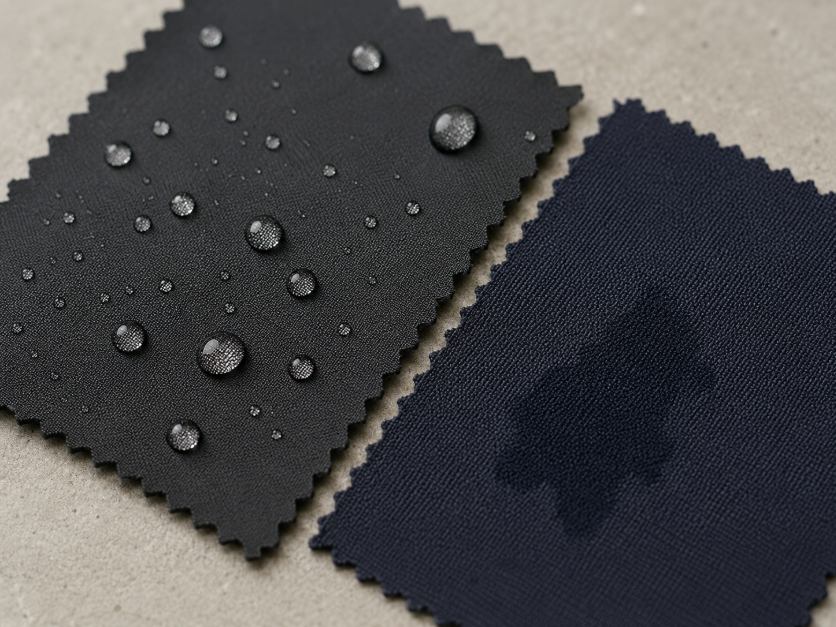
For outdoor use, polyester is often selected when the project prioritizes UV exposure, color stability, moisture behavior, and dimensional stability. Nylon can still work outdoors when the project prioritizes flex, low weight, abrasion, or a specific coated construction. The decision should follow the exposure condition, not a generic “outdoor fabric” label.
Water-resistant fabric can slow water penetration, shed light moisture, or resist brief exposure. Waterproof fabric requires a coating, lamination, membrane, seam strategy, or construction method that blocks water under the intended pressure and duration.
A DWR finish can help water bead on the surface, but DWR is not the same as waterproof construction. Canvas ETC’s coating guide explains that PU and PVC coatings can add water resistance or waterproofness, while DWR is a surface repellency finish that wears down over time.
For covers, tarps, awnings, marine uses, and outdoor storage, evaluate the full fabric system: base fiber, denier, weave, coating, seam design, UV exposure, cleaning method, and expected service life. For deeper project context, see best marine canvas material, marine fabric uses, and RV awning and upholstery fabrics.
Denier, weave, and coating can change the answer to nylon vs polyester because they modify how the finished fabric handles weight, abrasion, tear behavior, water, stiffness, and long-term durability. Canvas ETC defines denier as yarn linear mass density and emphasizes that material, weave, yarn quality, and coatings modify final performance.
For a deeper explanation, see Canvas ETC’s guide on how to choose denier fabric.
Higher denier usually means thicker, heavier yarns. Thicker yarns can increase durability potential, but denier alone does not prove that a finished fabric will resist abrasion, tearing, UV exposure, or water penetration.
A lightweight 70D ripstop nylon can be useful where packed weight and tear control matter. A 420D nylon fabric can be useful for bags and gear. A 1000D nylon can be useful for high-wear applications. A 600D polyester can be useful for covers, banners, and outdoor applications when UV exposure, moisture behavior, printability, or dimensional stability matter.
Weave structure changes how yarns interact under stress. Canvas ETC’s weave guide explains that weave structure affects texture, tensile strength, tear strength, drape, breathability, and overall durability.
A ripstop weave helps limit tear spread by reinforcing the fabric grid, while a dense ballistic-style construction is used where toughness and abrasion resistance are priorities. Plain, oxford, ripstop, and ballistic constructions should not be treated as interchangeable just because the fiber is nylon or polyester.
For more detail, see denier fabric weave types: plain vs oxford vs ripstop.
Coatings can matter more than base fiber when the target requirement is waterproofness. PU coatings, PVC coatings, vinyl coatings, laminates, and DWR finishes modify the base fabric in different ways. Canvas ETC’s coating guide explains that these treatments modify base fabrics by adding water resistance, durability, flexibility, or repellency, and it distinguishes DWR from waterproof construction.
For a waterproof outdoor cover, a coated polyester may be a better starting point than an uncoated nylon. For a flexible high-wear bag panel, a high-denier nylon may be a better starting point than a stiff coated material. The correct decision follows the project requirement.
For more detail, see denier fabric coatings and water-resistant fabric meaning.
Polyester is often the better starting point for print-focused and color-stable applications, while nylon may be better when flexibility, hand, or high-wear performance matters more. The printing method, dye system, coating, finish, heat exposure, and end use should be verified before production.
For dye sublimation and many display applications, polyester is commonly used because the printing process often aligns with polyester chemistry and heat transfer requirements. For coated banners, display graphics, and event materials, polyester or vinyl-coated polyester may be more appropriate than nylon.
For deeper print-method context, use these Canvas ETC resources:
Care instructions should follow the finished fabric, not just the fiber name. Coated fabrics, printed fabrics, flame-retardant fabrics, mesh fabrics, and heavy denier fabrics can have different cleaning, heat, drying, and storage requirements. Do not apply generic apparel laundry guidance to coated industrial fabric, marine fabric, display fabric, or technical denier fabric without checking the product specification.
Neither nylon nor polyester is automatically sustainable. Both are synthetic materials, and environmental impact depends on feedstock, manufacturing, durability, recycled content, laundering behavior, repairability, useful life, and end-of-life pathway.
Polyester may have more widely available recycled PET pathways in some markets, while recycled nylon availability depends on source material, supplier, and product type. Textile Exchange reporting covered by Vogue Business states that global fiber production reached 132 million tonnes in 2024 and that polyester represented 59% of fiber production, underscoring why polyester-related sourcing and recycling claims need careful sourcing rather than broad “eco-friendly” language.
For buyers, the practical sustainability question is not “Which synthetic fiber is good?” The practical question is: which fabric will perform correctly, last long enough, avoid premature replacement, and fit an available reuse, repair, recycling, or disposal pathway?
Related Canvas ETC reading:
Canvas ETC fabric options should be treated as starting points for specification review, not universal recommendations. The right fabric depends on denier, width, coating, color, finish, weave, order quantity, and end use.
| If you need… | Canvas ETC starting point to review | Why it may fit | Validate before ordering |
|---|---|---|---|
| Bag lining, midweight gear, or packcloth | nylon packcloth, 420D nylon fabric, or 420D nylon pack cloth | Useful where flexibility and abrasion resistance matter. | Width, color, weight, finish, and availability. |
| Heavy-wear gear, luggage, or reinforcement | 1000D nylon or 1050D ballistic nylon | Useful where toughness and abrasion are major concerns. | Denier, weave, finish, color, and product status. |
| Lightweight tear control | 70D nylon ripstop or 70D black ripstop nylon | Useful where low weight and tear control matter. | Denier, coating, width, color, and intended use. |
| Outdoor covers, displays, or banners | 600D polyester or 600D polyester woodland camo | Useful where UV, moisture, printability, or dimensional stability matter. | Coating, width, finish, color, and print compatibility. |
| Waterproof or heavy-duty barriers | 18 oz vinyl-coated polyester, 18 oz vinyl polyester black, or 18 oz vinyl-coated polyester royal blue | Useful where coating performance is central. | Coating type, weight, width, and waterproof/water-resistant claims. |
| Ventilation or mesh applications | polyester mesh fabric, poly mesh fabric, or vinyl-coated polyester mesh | Useful where airflow, openness, or coated mesh behavior is needed. | Mesh opening, coating, width, and load requirements. |
Before production, review the live product page and order printed fabric swatches/samples when the project depends on hand feel, stiffness, color, coating feel, print behavior, or sewing performance.
Verify nylon or polyester fabric by matching the project requirement to the fabric specification. The safest selection workflow is to define the failure risk first, then compare fiber, denier, weave, coating, width, finish, and sample behavior.
This workflow turns the polyester vs nylon comparison into a fabric-selection process instead of a generic material preference.FAQs About Nylon vs Polyester
Nylon is usually the stronger starting point when the requirement is abrasion resistance, toughness, or stretch. Polyester can still be durable, especially in higher deniers or coated constructions, but nylon is often selected for high-wear gear, straps, luggage, and reinforcement panels. Canvas ETC’s denier guide identifies nylon as stronger for abrasion and tear-resistance priorities while emphasizing that denier, weave, and coatings modify final performance.
Neither nylon nor polyester is waterproof by fiber alone. Polyester generally absorbs less water than nylon, but waterproof fabric requires a coating, lamination, membrane, seam strategy, or construction method that blocks water under the intended pressure and duration. Canvas ETC’s coating guide distinguishes DWR surface repellency from waterproof coating systems.
Polyester usually dries faster because polyester generally absorbs less moisture than nylon. Finished-fabric drying behavior can still change with weave, coating, fabric weight, lining, backing, and finish. Canvas ETC’s denier guide describes polyester as having lower water absorption than nylon and better dimensional stability when wet.
Polyester is usually the better starting point for prolonged outdoor exposure because outdoor fabric often needs UV resistance, lower water absorption, and dimensional stability. Nylon may still fit outdoor applications when abrasion, flex, low weight, or a specific coated construction is more important.
Nylon is often the better starting point for bags that need abrasion resistance, flex, and high-wear durability. Polyester can be the better starting point for bags or covers that need UV exposure resistance, lower water absorption, printability, or cost-sensitive production. For bag-specific material planning, see Canvas ETC’s guide to the best fabric for bag linings and best fabric for industrial bags and sacks.
Nylon or polyester can work for tents depending on the design priority. Ripstop nylon is often useful where low weight and tear control matter, while polyester can be useful where UV exposure and wet dimensional stability matter. Coating and seam construction are critical for rain performance. For tent-related buying guidance, see a helpful quick guide to buying tent fabrics and tent canvas fabric projects.
Polyester is often the better starting point for print-focused fabric, especially where the print method is designed for polyester or coated polyester. Before production, verify the print process, coating, finish, heat settings, color target, and fabric width. For print-method context, see printed cotton fabric dye sublimation vs screen printing and large-format fabric printing.
Denier can matter as much as the fiber choice because denier affects yarn size, weight, and durability potential. Denier does not decide performance alone, so compare denier with fiber type, weave, coating, finish, and intended use. Canvas ETC’s denier guide specifically warns not to choose based on denier alone.
Neither nylon nor polyester is inherently sustainable. Sustainability depends on feedstock, recycled content, manufacturing, durability, laundering, microfiber shedding, repairability, reuse, and end-of-life pathway. Use current sustainability evidence before making any broad environmental claim.
Choose nylon when the project is most likely to fail from abrasion, stretching, pulling, flexing, or repeated high-wear contact. Choose polyester when the project is most likely to fail from sun exposure, moisture, shape distortion, print instability, or cost constraints. Choose a coated or laminated fabric when the project requires waterproofness, because waterproof performance depends on the full fabric system rather than the fiber name alone.