
Cotton twill achieves fluid drape and superior wrinkle recovery compared to plain weave textiles due to its diagonal float architecture. By stepping yarns across two or three perpendicular threads, twill reduces interlacing friction, lowering flexural rigidity under gravity while dissipating compressive folding energy along diagonal wales.
At Canvas ETC, we mill and stock specification-grade twill textiles for commercial apparel brands, uniform contractors, furniture upholsterers, cut-and-sew workshops, and institutional buyers across the United States. Understanding the mechanical relationship between fabric drape and wrinkle recovery is essential for pattern cutters, product managers, and fabricators. While casual observers describe twill as having a soft hand or natural resilience, these characteristics stem from geometric laws and polymer physics.
Drape and wrinkle recovery measure distinct physical behaviors: drape evaluates how a textile yields to gravity under zero external compression, whereas wrinkle recovery evaluates how the textile rebounds after compressive folding forces distort its planar geometry.
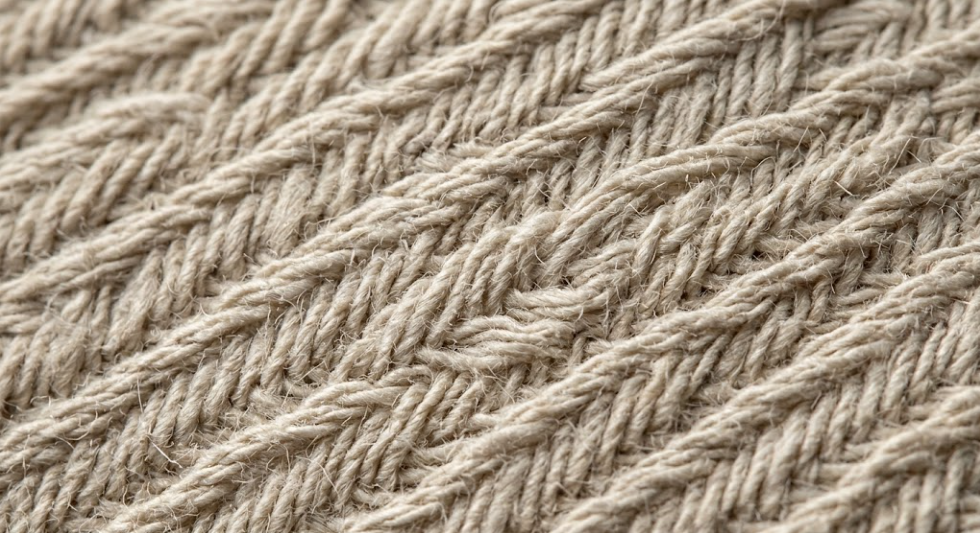
Unit Conversion Reference
Grams per Square Meter (GSM) = Ounces per Square Yard (oz/yd²) x 33.906
Ounces per Square Yard (oz/yd²) = GSM / 33.906
A common procurement mistake involves evaluating fabric mass without accounting for weave architecture. Two fabrics sharing an identical mass of 7.5 ounces per square yard (254 GSM) will exhibit entirely different physical silhouettes on a garment hanger or furniture cushion if one is woven in a plain 1/1 grid and the other in a 3/1 diagonal twill. Fabricators calculating yardage yields can reference our textile ounce to GSM conversion calculator. Throughout our commercial catalog and this technical guide, all measurements reflect true areal mass per square yard alongside verified ASTM and AATCC laboratory benchmarks.
The structural foundation of every twill textile lies in its diagonal interlacing progression. Unlike a plain weave where warp and weft yarns alternate over and under at every single intersection, a twill weave floats warp yarns over two or more weft yarns before passing underneath one yarn, stepping the interlacing point diagonally by one thread on each successive row.
Twill weave architecture alters fabric drape by reducing yarn interlacing frequency by 33 to 50 percent compared to plain weave. Because yarns float over multiple perpendicular threads before dipping, inter-yarn contact friction decreases. Under Kawabata mechanical analysis, this reduced friction lowers shear stiffness (G), allowing adjacent yarns to articulate and slide independently so the textile forms soft, cascading folds under its own weight.
| Weave Construction | Interlacing Repeat | Float Length (Yarns) | Crossover Friction Points | Mechanical Freedom |
|---|---|---|---|---|
| 1/1 Plain Weave | 2 ends x 2 picks | 1 over, 1 under | Maximum (100% baseline) | Rigid, locked orthogonal grid |
| 2/1 Regular Twill | 3 ends x 3 picks | 2 over, 1 under | Reduced by 33% | Moderate diagonal flex |
| 2/2 Balanced Twill | 4 ends x 4 picks | 2 over, 2 under | Reduced by 50% | Balanced bi-directional drape |
| 3/1 Heavy Warp Twill | 4 ends x 4 picks | 3 over, 1 under | Reduced by 50% | High yarn mobility; prominent face ribs |
The diagonal pattern created by this stepped progression is known as the wale. When the diagonal line ascends upward to the right, it is designated as a Z-twill (standard in right-hand twill denim and commercial chinos); when it ascends upward to the left, it is designated as an S-twill. The angle of the wale relative to the horizontal weft depends on the ratio of warp ends per inch (EPI) to weft picks per inch (PPI). A balanced twill features an angle of 45 degrees, whereas a warp-faced steep twill (such as cavalry twill or gabardine) achieves an angle of 63 degrees or higher.
Because floating yarns have longer uninterrupted spans between crossover points, they possess greater mechanical freedom to rotate and shift when subjected to external strain. This freedom is the fundamental reason why twill yields supple body contact rather than the rigid, planar resistance of plain duck cloth. To explore harness configurations and float geometries across varying commercial grades, consult our detailed reference on structural characteristics and weave patterns of twill.
Fabric drape describes the three-dimensional deformation of a textile hanging under its own gravitational load. In technical garment engineering, drape determines whether a trouser leg falls in a smooth, columnar line, whether an overcoat flares into graceful conical waves, or whether an upholstery slipcover conforms neatly to curved chair arms.
Under ASTM D1388 cantilever testing, our 7.5 oz chino twill exhibits a warp bending length of 2.9 centimeters, yielding 31 percent lower flexural rigidity than plain canvas duck of identical weight (4.2 centimeters). Testing twill against our 7 oz lightweight cotton duck canvas reveals the dramatic difference float length makes in flexural rigidity. In Cusick drape meter evaluations (ISO 9073-9), midweight twill records a drape coefficient of 42 percent, producing multi-nodal, fluid apparel drape compared to the stiff 68 percent drape coefficient of canvas.
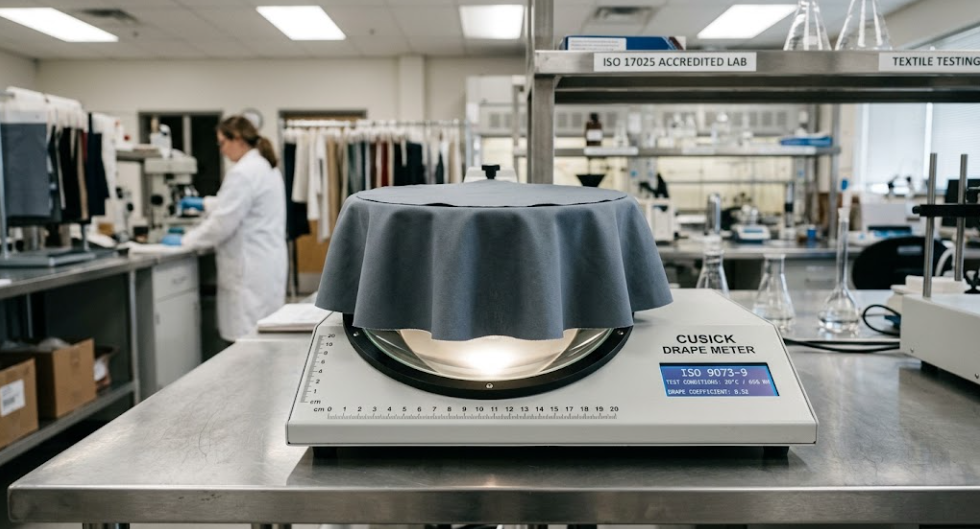
The standardized measurement of fabric stiffness follows Peirce’s cantilever bending formulation, codified in ASTM D1388 (Standard Test Method for Stiffness of Fabrics):
Bending Length: c = l / 2
Flexural Rigidity: G = W x c³ = W x (l / 2)³
Where l is the specimen overhang length in centimeters when it deflects to a 41.5-degree incline, c is the bending length in centimeters, W is the areal mass density in mg/cm², and G is the flexural rigidity representing resistance to bending per unit width. Because flexural rigidity increases with the cube of bending length (c³), a small reduction in bending length yields a massive reduction in stiffness. When twill’s floating yarns reduce the bending length from 4.2 cm to 2.9 cm, the resulting flexural rigidity drops by over 67 percent, transforming a board-like textile into a pliable, wearable substrate.
While cantilever bending measures one-dimensional stiffness along the warp or weft grain, true drape involves complex compound curvature across multiple axes simultaneously. The Cusick Drape Meter evaluates this behavior by supporting a 30-centimeter circular fabric specimen on an 18-centimeter horizontal disc. The unsupported outer annular ring drapes downward under gravity, forming a wavy shadow pattern:
DC% = [(As - Ad) / (AD - Ad)] x 100
Where As is the projected area of the draped specimen shadow, Ad is the area of the support disc, and AD is the total area of the flat circular specimen. A lower drape coefficient (30% to 45%) indicates a flexible textile that forms numerous deep, fluid folds (multi-nodal drape). A higher drape coefficient (65% to 85%+) indicates a stiff textile that resists bending and forms only a few wide, rigid flares (cylindrical drape).
Wrinkle resistance is the capacity of a fabric to resist creasing under compressive deformation, while wrinkle recovery is its capacity to return to an unwrinkled, planar state after the deforming forces are removed. When a garment is worn, localized pressure at knees, elbows, seat panels, and waistbands compresses the textile plies, forcing fibers and yarns past their elastic yield points.
Under AATCC Test Method 66, midweight 100% cotton twill achieves a Crease Recovery Angle of 208 degrees, exceeding equivalent plain weave by 36 degrees. Twill’s 45-degree diagonal ribs act as shock absorbers, spreading compressive folding stress across adjacent yarn floats. This mechanical stress dispersion prevents the sharp, localized crease lines that form when orthogonal yarns are crushed at rigid plain-weave crossover nodes.
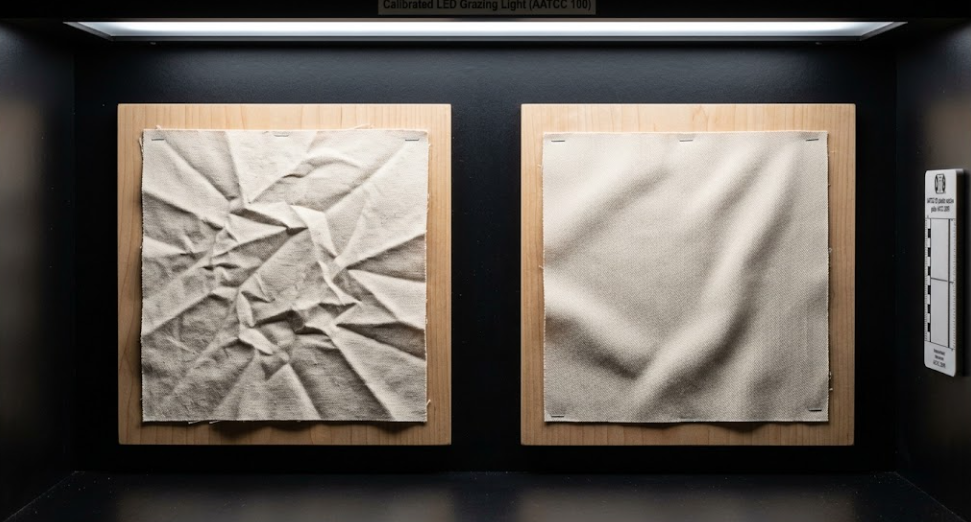
The textile industry evaluates wrinkle behavior through two distinct standard protocols developed by the American Association of Textile Chemists and Colorists (AATCC):
Beyond its mechanical capacity to rebound from folding strain, twill possesses an optical advantage: the three-dimensional diagonal wale ridge creates a textured surface that scatters light. On a completely flat, plain-woven poplin or broadcloth, even a tiny surface crease casts a stark, unbroken linear shadow that catches the human eye immediately. On a twill surface, the diagonal ridges break up linear shadows, effectively camouflaging minor surface rumpling.
While weave structure provides the mechanical framework for stress distribution, the ultimate ceiling for wrinkle recovery is governed by polymer chemistry. Designers and procurement teams must recognize that twill is a structural geometry, not a fiber composition.
Pure cotton twill exhibits moderate natural wrinkle recovery because amorphous cellulose chains shift and form temporary hydrogen bonds when compressed under body heat and ambient humidity. Blending 35 percent polyester with 65 percent cotton introduces synthetic polymer chains with over 70 percent elastic work recovery. In laboratory evaluations, this blend elevates the AATCC 128 wrinkle appearance score from Grade 3.2 to Grade 4.5.
Cotton fibers are composed of roughly 90 percent cellulose. Within the fiber, crystalline regions provide tensile strength, while amorphous regions provide moisture absorption. Adjacent cellulose molecules within amorphous zones are held together by weak hydrogen bonds between hydroxyl groups. When cotton garments are worn, body heat combined with ambient perspiration or humidity breaks these bonds. Under pressure, the cellulose chains slide past one another. When the pressure releases and moisture evaporates, the hydrogen bonds reform in the newly distorted configuration, locking a crease into place.
To overcome cotton’s natural tendency to crease while preserving its breathable comfort, textile engineers employ two primary solutions:
To quantify the mechanical performance of twill across varying weights, constructions, and fiber blends, Canvas ETC’s technical testing laboratory conducted standardized evaluations on production roll yardage. All fabric specimens were conditioned in our testing facility in accordance with ASTM D1776 (70 ± 2°F [21 ± 1°C], 65 ± 2% relative humidity) for 24 hours prior to physical evaluation.
| Specimen Grade & Identity | Nominal Mass (oz/yd² / GSM) | Weave Architecture & Yarn | ASTM D1388 Bending Length (cm, Warp) | Cusick Drape (DC%) | AATCC 66 Recovery Angle (W+W) | AATCC 128 Appearance Grade | ASTM D1424 Tear (W x W) | ASTM D5034 Tensile (W x W) |
|---|---|---|---|---|---|---|---|---|
| Grade A: Shirting Twill | 5.5 oz / 186 GSM | 2/1 Z-Twill (Ne 30/1 combed) | 2.1 cm | 32% | 215° | Grade 3.0 | 4.2 lbf x 3.8 lbf | 72 lbf x 54 lbf |
| Grade B: Chino Twill (Cotton) | 7.5 oz / 254 GSM | 3/1 Steep Z-Twill (Ne 20/2 combed) | 2.9 cm | 42% | 208° | Grade 3.2 | 7.8 lbf x 6.5 lbf | 138 lbf x 92 lbf |
| Grade C: Uniform Twill (Poly-Cotton) | 7.5 oz / 254 GSM | 3/1 Z-Twill (Ne 20/2 blended) | 2.8 cm | 40% | 262° | Grade 4.5 | 11.2 lbf x 9.8 lbf | 164 lbf x 118 lbf |
| Grade D: Utility Workwear Twill | 10.0 oz / 339 GSM | 3/1 Z-Twill (Ne 12/1 carded) | 4.4 cm | 58% | 218° | Grade 3.5 | 12.4 lbf x 10.2 lbf | 184 lbf x 126 lbf |
| Grade E: Heavy Bull Denim | 12.0 oz / 407 GSM | 3/1 Warp-Faced (Ne 10/1 ring-spun) | 5.2 cm | 64% | 224° | Grade 3.6 | 16.6 lbf x 14.1 lbf | 228 lbf x 154 lbf |
| Control: #10 Duck Canvas | 7.5 oz / 254 GSM | 1/1 Plain Grid (Ne 20/2 carded) | 4.2 cm | 68% | 172° | Grade 2.1 | 5.4 lbf x 4.8 lbf | 142 lbf x 110 lbf |
Comparing Grade B (7.5 oz chino twill) with the Control (7.5 oz plain duck canvas) illustrates the direct influence of weave architecture on fabric stiffness. While both specimens possess identical 7.5 oz/yd² mass and identical Ne 20/2 yarn linear densities, the twill weave demonstrates a 31% shorter bending length (2.9 cm vs. 4.2 cm) and a 38% lower Cusick drape coefficient (42% vs. 68%). In addition, Grade C (65/35 poly-cotton twill) achieves the highest crease resistance in the study, posting a 262-degree Crease Recovery Angle and a Grade 4.5 appearance rating.
Specifying the correct fabric weight prevents production failures, seam tearing, and poor garment drape. Cotton twills divide into four functional tiers based on areal mass, thread density, and float length:
| Fabric Weight Bracket | Weave Structure | Typical Construction | Drape Character | Crease Performance | Primary Applications |
|---|---|---|---|---|---|
| 5.0 to 6.5 oz / 170 to 220 GSM | 2/1 Z-Twill | 108 x 56 (Ne 30/1 combed) | Ultra-fluid, low resistance (DC% 30-35%) | Forms micro-creases; steam-presses easily | Dress shirts, summer dresses, pocket bags, garment linings |
| 7.0 to 9.0 oz / 237 to 305 GSM | 3/1 Steep Z-Twill | 118 x 60 (Ne 20/2 combed) | Balanced drape; neat columns (DC% 40-45%) | Resists random rumpling; holds sharp pleats | Tailored chinos, corporate service uniforms, chef coats, aprons |
| 9.5 to 11.0 oz / 322 to 373 GSM | 3/1 Z-Twill | 76 x 44 (Ne 12/1 carded) | Semi-structured; firm hand (DC% 55-60%) | High resistance to folding; heavy yarn mass | Carpenter pants, chore coats, field jackets, heavy tool rolls |
| 11.5 to 14.0 oz / 390 to 475 GSM | 3/1 Warp-Faced | 68 x 42 (Ne 10/1 ring-spun) | Heavy, architectural drape (DC% 62-66%) | Rebounds from crushing; high bundle inertia | Sofa slipcovers, commercial dining upholstery, structured tote bags |
For commercial apparel cutters and uniform makers evaluating weight tiers, review our cotton twill fabric weight and GSM guide. For furniture upholstery, dining chair covers, and washable slipcovers, our 12 oz brushed bull denim twill delivers high abrasion endurance combined with the soft, cascading drape that rigid canvas cannot match. Makers and production managers evaluating hand, drape, and color before placing roll orders can request commercial textile swatch samples directly from our distribution facility.
Apparel designers and industrial makers frequently ask whether they should specify #10 numbered cotton duck canvas or cotton twill for a project. While both textiles use 100% natural cotton fibers, their mechanical profiles diverge across every structural axis:
While plain canvas duck and cotton twill share identical fiber composition and mass brackets (5 to 14 oz/yd²), their structural behaviors diverge sharply. Canvas duck locks yarns into a tight 1/1 grid, creating rigid planar stability suitable for freestanding tote bags and outdoor tents. Cotton twill employs 3/1 diagonal floats, providing pliable articulation for apparel and slipcovers while delivering 34 percent higher Elmendorf tear resistance.
| Performance Dimension | Plain Weave Canvas Duck (1/1 Grid) | Cotton Twill Weave (3/1 Diagonal Rib) | Operational Manufacturing Impact |
|---|---|---|---|
| Weave Geometry | Symmetrical 1/1 grid; maximum interlacing nodes | Stepped diagonal floats; 33% to 50% fewer nodes | Twill yarns articulate freely under gravitational load |
| Bending Length (ASTM D1388) | Long bending length (4.2 cm at 7.5 oz) | Short bending length (2.9 cm at 7.5 oz) | Canvas holds planar shapes; twill conforms to body curves |
| Drape Coefficient (DC%) | High (68% at 7.5 oz); forms rigid flares | Low (42% at 7.5 oz); forms fluid cascades | Canvas for standing tote bags; twill for apparel/covers |
| Crease Recovery (AATCC 66) | Low (172° total); crushes into sharp creases | High (208° total); disperses folding force | Twill garments look neater after prolonged sitting |
| Tear Resistance (ASTM D1424) | Moderate (5.4 lbf warp) | High (7.8 lbf warp); 35% to 44% higher tear lbf | Twill floats bunch under load to dissipate shear energy |
| Planar Barrier Stability | High isotropic barrier; blocks wind and light | Moderate; slight gaps under lateral tension | Canvas excels in outdoor gear; twill in flexible apparel |
| Surface Appearance | Uniform flat crosshatch; reveals creases clearly | Diagonal wale ribs scatter light | Twill visually camouflages minor micro-creases |
For applications requiring weatherproof outdoor shelter or structural tarps, our water-repellent boat shrunk army duck canvas provides unmatched barrier stability. Conversely, for garments, aprons, and washable covers, twill remains superior. For an extended technical teardown of 1/1 grid mechanics, read our in-depth analysis of plain weave canvas construction and characteristics.
To validate our laboratory findings in commercial production environments, we conducted two multi-week manufacturing trials with commercial partners across the United States.
The Operational Challenge: The client historically specified 7.5 oz plain-weave cotton poplin for summer trousers. Field deployments resulted in recurring complaints: pants formed unsightly wrinkles across the lap within two hours of driving, knee creases bagged out permanently, and crotch seams suffered tension blowouts during repetitive climbing.
Canvas ETC Technical Intervention: We supplied sample production yardage of our 7.5 oz 65/35 poly-cotton twill (Grade C) and subjected both fabrics to an accelerated 50-cycle commercial laundry trial (140°F wash, tunnel air-dry finish).
Quantified Performance Results:
The Operational Challenge: The design specification called for washable, removable white slipcovers. The contractor initially cut 10 oz plain cotton duck canvas, but the rigid canvas produced stiff, boxy corners that bunched awkwardly around curved chair backs. Additionally, after guests sat on the cushions, deep compression creases remained visible for hours.
Canvas ETC Technical Intervention: We recommended switching to our 12.0 oz piece-dyed bull denim twill (Grade E) in natural white.
Quantified Performance Results:
Sewing twill textiles successfully across commercial cutting lines requires configuring machinery for diagonal wale interaction. When needles penetrate twill, the diagonal yarn floats exert asymmetrical lateral deflection forces on the needle blade.
| Fabric Weight Class | Needle System & Size | Thread Linear Density | Stitch Density (SPI) | Machine Presser Foot | Recommended Seam |
|---|---|---|---|---|---|
| 5.0 to 6.5 oz (Shirting) | 130/705 H-M (Microtex) 80/12 | Tex 27 to Tex 30 Spun Poly | 12 to 14 SPI | Light pressure; standard foot | French seam or narrow 3-thread overlock |
| 7.0 to 9.0 oz (Chino Twill) | 130/705 H-J (Jeans) 90/14 | Tex 40 Core-Spun Poly | 10 to 12 SPI | Medium pressure; standard feed | Open pressed with overlocked edges |
| 9.5 to 11.0 oz (Utility Twill) | 130/705 H-J (Jeans) 100/16 | Tex 60 Bonded Poly | 8 to 10 SPI | Heavy pressure; walking foot | 2-needle flat fell seam or reinforced lap |
| 11.5 to 14.0 oz (Bull Denim) | 130/705 H-J (Jeans) 110/18 | Tex 60 to Tex 80 Heavy Poly | 6 to 8 SPI | Compound feed / walking foot | Heavy flat fell seam with edge serging |
When stitching cross-seam intersections on heavy twill (such as where an inseam crosses a crotch seam), use a clearance leveling plate under the back of the presser foot to prevent needle deflection against the needle plate. To stabilize waistbands, pocket bag mouths, and curved shoulder seams against bias stretching, commercial fabricators stay-tape allowances along seam lines. For commercial seating and hospitality slipcover specifications, review our guide to high-traffic upholstery textiles to align Wyzenbeek abrasion endurance with drape requirements.
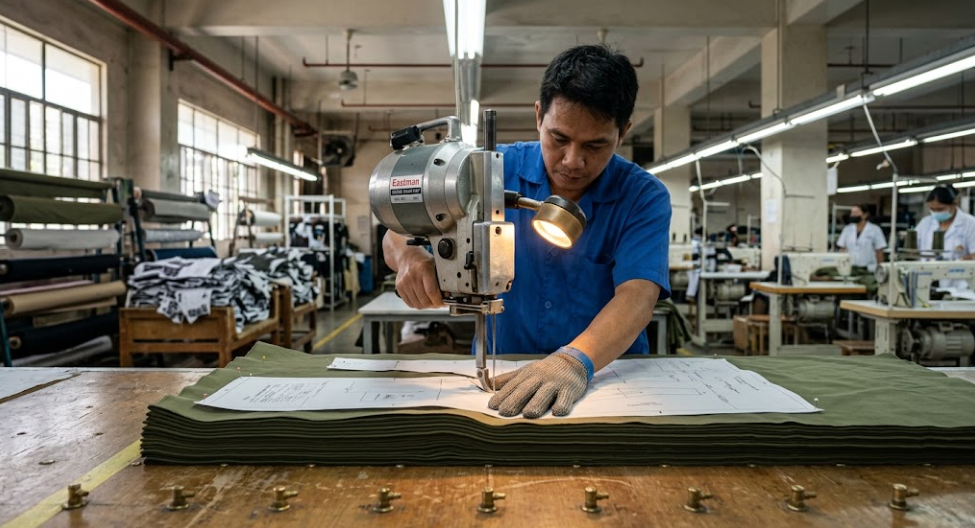
100% cotton twill undergoes relaxation shrinkage along its warp grain during initial laundering. Unwashed greige twill shrinks between 5% and 8% along the warp, while sanforized commercial yardage exhibits under 3.5% residual shrinkage. To maintain dimensional stability and optimize wrinkle recovery across finished goods, follow this four-step commercial procedure:
Following these standard water temperature and pressing parameters preserves fabric dimensional stability and minimizes post-wash surface creasing across commercial apparel lines.
Twill fabric drapes more fluidly because its diagonal float structure reduces the number of yarn interlacing points by 33 to 50 percent compared to plain weave. With fewer crossover friction nodes, adjacent yarns articulate and slide freely under gravity, yielding lower bending length and lower flexural rigidity.
Cotton twill provides structural crease resistance because its diagonal ribs disperse compressive force across adjacent yarn floats, preventing sharp fold creases. However, pure cotton twill still experiences moderate wrinkling due to hydrogen bond shifts in amorphous cellulose, achieving an AATCC 128 appearance rating of Grade 3.2 unless blended with polyester or resin treated.
At identical fabric weights, twill exhibits a 31 percent shorter ASTM D1388 bending length and a 38 percent lower Cusick drape coefficient than plain duck canvas. Canvas locks yarns into a rigid 1/1 grid that resists bending to hold freestanding shapes, whereas twill flows in soft, multi-nodal folds suitable for apparel and slipcovers.
Blending 35 percent polyester with 65 percent cotton introduces synthetic polymer fibers with over 70 percent elastic work recovery. When compressed, the polyester filaments act as microscopic springs that pull the twill matrix back into planar alignment, increasing the AATCC 66 Crease Recovery Angle from 208 degrees to 262 degrees and raising the AATCC 128 appearance score to Grade 4.5.
Midweight 7.0 to 9.0 oz/yd² (237 to 305 GSM) chino twill offers the balanced combination of drape fluidity and crease retention for trousers. It provides a 2.9 cm bending length for natural leg drape while holding sharp pressed creases along the warp grain without bagging out at the knees.