
Cotton twill fabric ranges from 5 to 14 ounces per square yard (170 to 475 GSM), categorized into lightweight shirting (5.0 to 6.5 oz), midweight apparel (7.0 to 9.0 oz), utility workwear (9.5 to 11.0 oz), and heavyweight bull denim (11.5 to 14.0 oz) based on yarn density.
Quick Reference Parameters:
At Canvas ETC, we mill, finish, and distribute specification-grade cotton twill textiles for makers, apparel brands, cut-and-sew workshops, and institutional buyers across the United States. Choosing the correct fabric weight determines whether a finished product delivers comfortable joint articulation or structural resistance under load.
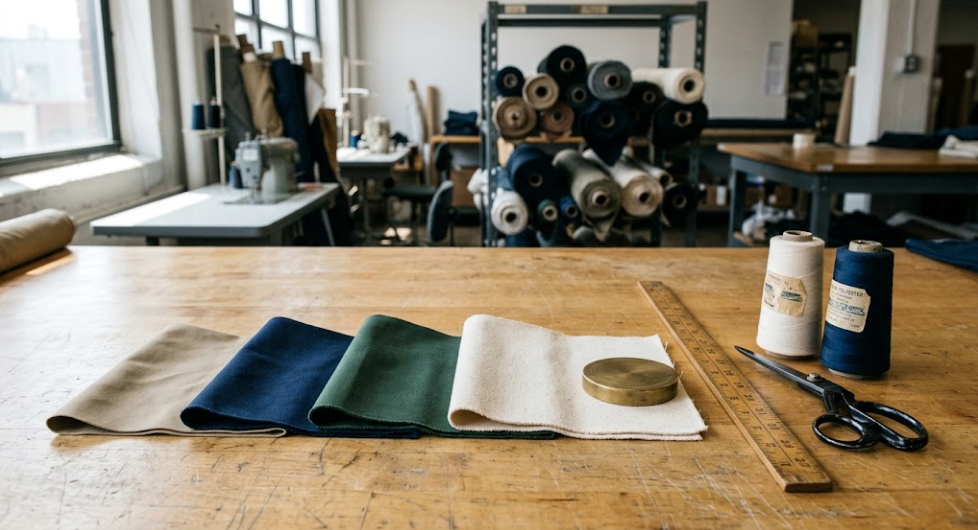
A frequent procurement pitfall involves confusing square yard weight with linear yard weight. A linear yard measures 36 inches along the roll length, but its physical mass depends on loom width. For example, a 10-ounce linear yard cut from a narrow 45-inch bolt yields an areal density of only 8.0 oz/yd² (271 GSM). Conversely, the same 10-ounce linear yard cut from a wide 60-inch roll yields 6.0 oz/yd² (203 GSM). Throughout our inventory catalog and this technical reference, all ounce ratings reflect true areal density per square yard.
Cotton twill divides into four functional tiers based on yarn linear density (English Cotton Count Ne), thread packing (ends and picks per inch), and weave float architecture (2/1 versus 3/1). The following master conversion matrix details construction metrics across our commercial inventory:
| Areal Weight (oz/yd²) | Metric Density (GSM) | Yarn Linear Density (Ne) | Thread Density (EPI x PPI) | Weave Architecture | Primary Industrial Applications |
|---|---|---|---|---|---|
| 5.5 oz | 186 GSM | 30/1 ring-spun combed | 108 x 56 | 2/1 Z-twill | Button-down shirts, summer dress linings, warm-weather culinary coats |
| 7.5 oz | 254 GSM | 20/2 two-ply combed | 118 x 60 | 3/1 steep Z-twill | Tailored chinos, casual trousers, service uniforms, structured skirts |
| 8.5 oz | 288 GSM | 16/1 ring-spun carded | 96 x 52 | 3/1 Z-twill | Commercial kitchen aprons, institutional maintenance jackets, mechanics pants |
| 10.0 oz | 339 GSM | 12/1 open-end carded | 76 x 44 | 3/1 Z-twill | Carpenter trousers, chore jackets, tactical gear bags, tool roll wraps |
| 12.0 oz | 407 GSM | 10/1 ring-spun carded | 68 x 42 | 3/1 piece-dyed twill | Washable sofa slipcovers, dining upholstery, heavy winter work coats |
| 14.0 oz | 475 GSM | 8/1 coarse carded | 60 x 38 | 3/1 heavy utility | Machinery drop cloths, heavy tote bag shells, commercial acoustic drapes |
For apparel cutters seeking balanced drape and crease retention, our 7 oz midweight cotton twill provides dependable performance under repetitive home laundering. To examine float geometry, diagonal wale angles, and loom drafting in detail, review our guide to twill weave structure and wale patterns.
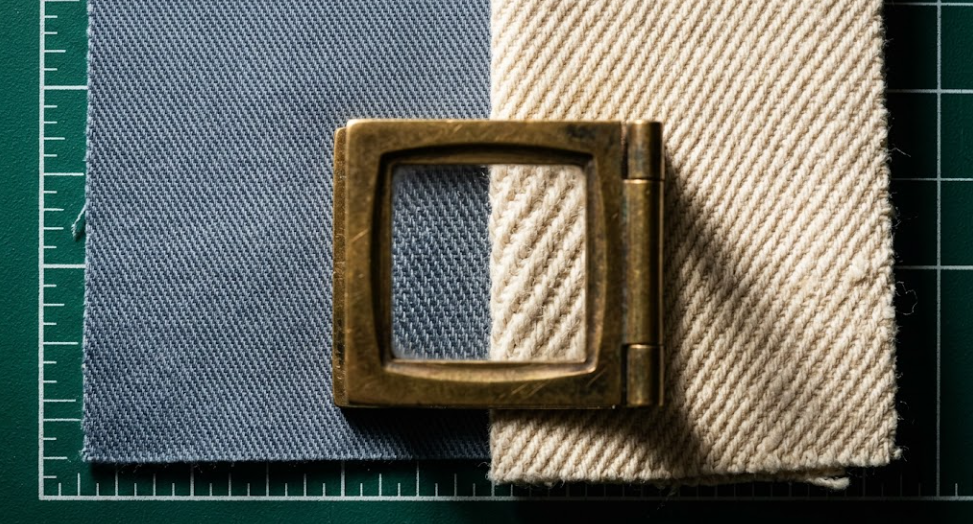
Deciding between 7.5 oz chino twill and 10.0 oz utility twill represents the most critical decision for apparel designers and commercial cutters. While both fabrics feature a 3/1 warp-faced diagonal rib, their physical yarn counts produce stark differences in flexural stiffness, tensile breaking force, and tear propagation.
Seven-ounce cotton twill provides an ASTM D1388 bending length of 2.9 centimeters for flexible apparel drape, whereas ten-ounce cotton twill exhibits a 4.4-centimeter bending length with an Elmendorf tear strength of 12.4 pounds-force. Under standardized falling-pendulum testing (ASTM D1424), ten-ounce twill demonstrates 34 percent higher tear resistance than plain-weave cotton canvas of identical mass because diagonal yarn floats bundle together under shear stress to dissipate tearing forces.
To quantify these mechanical differences, our quality assurance laboratory tested four production grades under controlled atmospheric conditions:
| Specimen Grade & Weight | ASTM D5034 Grab Tensile Force (Warp x Weft) | ASTM D1424 Elmendorf Tear Resistance (Warp x Weft) | ASTM D1388 Cantilever Bending Length (Warp) | AATCC 135 Laundering Dimensional Stability (3 Cycles @ 140°F) |
|---|---|---|---|---|
| Grade A: 5.5 oz Shirting (186 GSM) | 72 lbf x 54 lbf | 4.2 lbf x 3.8 lbf | 2.1 cm (Pliable drape) | -2.8% Warp x -1.2% Weft (Sanforized) |
| Grade B: 7.5 oz Chino (254 GSM) | 138 lbf x 92 lbf | 7.8 lbf x 6.5 lbf | 2.9 cm (Moderate drape) | -2.5% Warp x -1.1% Weft (Sanforized) |
| Grade C: 10.0 oz Utility (339 GSM) | 184 lbf x 126 lbf | 12.4 lbf x 10.2 lbf | 4.4 cm (Semi-structured) | -3.1% Warp x -1.4% Weft (Sanforized) |
| Grade D: 12.0 oz Bull Denim (407 GSM) | 228 lbf x 154 lbf | 16.6 lbf x 14.1 lbf | 5.2 cm (Firm structure) | -3.4% Warp x -1.5% Weft (Sanforized) |
Laboratory Testing Note: Tensile breaking evaluations were performed on a calibrated constant-rate-of-extension (CRE) machine at 12 inches per minute with 1×1-inch steel clamps. Elmendorf evaluations utilized a falling-pendulum apparatus. Dimensional change was calculated after three consecutive 140°F wash and high tumble cycles.
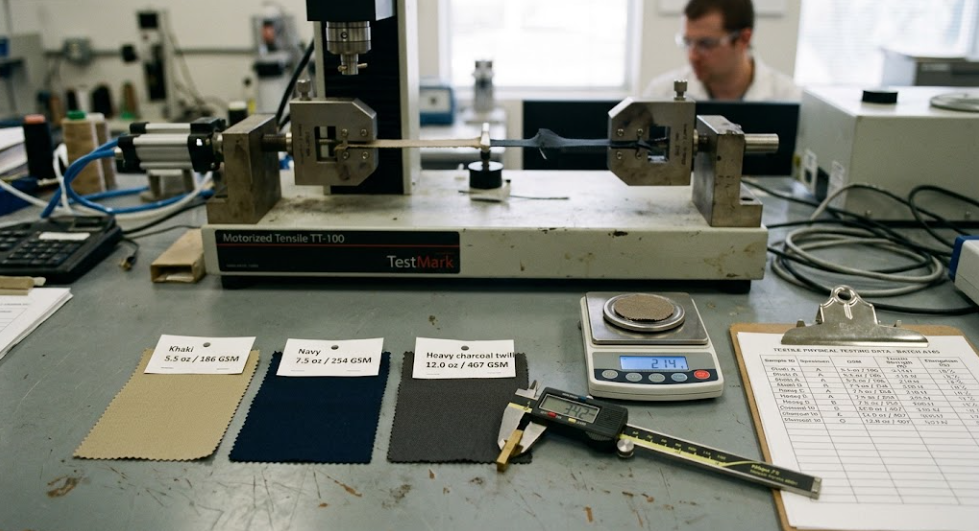
Our findings verify that Grade B (7.5 oz two-ply chino) achieves 75% of the tensile strength of Grade C (10.0 oz utility twill) while maintaining a 34% lower bending length. The two-ply Ne 20/2 yarn construction packs fibers tightly, yielding high burst strength without the rigid hand of single-ply 10 oz yarns. For tailored pants and lightweight jackets, 7.5 oz is balanced. When building commercial work trousers, heavy aprons, or tool bags, 10 oz provides necessary puncture resistance and abrasion longevity.
Cutters frequently evaluate whether to specify numbered cotton duck canvas or cotton twill of equivalent weight. While both fabrics utilize natural cotton fibers, their interlacing geometries respond differently to physical force:
| Performance Dimension | Plain Weave Canvas Duck | Cotton Twill Weave (3/1 Float Structure) | Operational Fabrication Impact |
|---|---|---|---|
| Weave Interlacing | 1/1 Over-under simple grid | 3/1 Offset diagonal float wales | Twill floats permit internal yarn sliding to dissipate shear energy. |
| Elmendorf Tear Strength | Moderate (Tear force concentrates on single threads) | High (34% to 48% higher tear lbf than duck) | Twill resists seam ripping and cut propagation under heavy stress. |
| Flexural Rigidity | Rigid, upright, board-like stiffness | Pliable, conforming diagonal drape | Canvas holds freestanding box shapes; twill contours around joints. |
| Puncture Resistance | Exceptional (Tight interlocked barrier) | Moderate (Yarn floats allow needle penetration) | Canvas is superior for tool rolls; twill is superior for apparel. |
| Snagging Susceptibility | Low (Short yarn bridges) | Moderate (Surface float bridges present catch points) | Canvas resists barbed branches; twill requires clean contact surfaces. |
| Abrasion Resistance | Isotropic flat surface friction | Wale ridge friction concentration | Heavy twill achieves high Wyzenbeek cycle endurance for upholstered cushions. |
For outdoor gear, boat covers, and rugged gear bags requiring barrier firmness, our waxed cotton canvas textiles deliver durable water repellency. For applications requiring washable flexibility and ergonomic drape, twill remains the preferred choice. For an extended engineering analysis, read our detailed canvas vs. twill weave comparison.
Specifying the proper weight bracket eliminates seam blowout and excessive garment weight. We group application specifications into four primary categories:
Lightweight cotton twill utilizes high yarn counts (Ne 30/1 to 40/1) woven in a 2/1 float structure. This yields an ASTM D1388 bending length under 2.5 centimeters, producing a breathable hand suitable for button-down dress shirts, blouses, interior pocket bags, and summer jackets. It feeds smoothly across standard domestic or light commercial feed dogs without puckering.
Midweight twill represents the industry standard for casual chinos, culinary coats, service uniforms, and chore shirts. Constructed with Ne 20/2 or Ne 16/1 yarns, this fabric delivers Elmendorf tear resistance between 7.5 and 9.5 pounds-force. It holds sharp creases along the warp grain while providing natural diagonal pliability across the 45-degree wale, eliminating seam tears at crotch gussets and knee stress points.
Utility-grade twill uses open-end carded yarns (Ne 12/1 to 10/1) packed at high ends per inch. With tensile breaking strength exceeding 180 pounds-force warp, this weight tier resists snagging, industrial friction, and aggressive laundering. It is specified for carpenter pants, work aprons, chore overshirts, and tote linings. When assembling pocket joins and waistband attachments, reinforcing seams with reinforcing cotton twill tape prevents seam stretching under load.
Bull denim is a heavy 10 to 14 ounce 100% cotton fabric woven in a 3/1 warp-faced twill and dyed in the piece for solid, uniform coloration. Exceeding 30,000 double rubs on the Wyzenbeek abrasion test (ASTM D4157), bull denim delivers the abrasion resistance and structural density needed for washable sofa slipcovers, dining upholstery, and work aprons while offering softer tactile drape than stiff canvas duck.
Our commercial bull denim fabric yardage features combed cotton yarns that accept piece dyeing and garment washing cleanly. For complete cutting layouts, seam allowances, and cushion construction guidelines, consult our guide to bull denim applications.
Sewing cotton twill across varying weights requires matching needle blade thickness, point geometry, and thread linear density. Attempting to stitch 10 oz utility twill or 12 oz bull denim with standard universal needles causes needle deflection, thread fraying, and skipped stitches across felled seam intersections.
Sewing ten-ounce cotton twill requires a Schmetz size 100/16 or 110/18 Jeans needle, Tex 60 bonded polyester thread, and a 3.5-millimeter stitch length. When assembling multi-layer flat fell seams or attaching pocket facings, a walking foot or compensating presser foot is necessary to feed dense plies evenly and prevent needle deflection, skipped stitches, and thread shearing.
| Fabric Weight Bracket | Schmetz Needle System & Size | Thread Linear Density | Stitch Length | Feed Dog & Presser Foot Setup | Recommended Seam Geometry |
|---|---|---|---|---|---|
| 5.0 to 6.5 oz (Shirting) | 130/705 H-M (Microtex) 80/12 | Tex 27 to 30 Spun Polyester | 2.0 to 2.5 mm | Standard feed dog, standard foot | French seam or 3-thread overlock serged edge |
| 7.0 to 9.0 oz (Chino Twill) | 130/705 H-J (Jeans) 90/14 | Tex 40 Core-Spun Polyester | 2.5 to 3.0 mm | Medium foot pressure, standard feed | Open pressed seam with serged allowances or mock fell |
| 9.5 to 11.0 oz (Utility Twill) | 130/705 H-J (Jeans) 100/16 | Tex 60 Bonded Polyester | 3.0 to 3.5 mm | Heavy foot pressure, walking foot recommended | Reinforced flat fell seam or double topstitched lap seam |
| 11.5 to 14.0 oz (Bull Denim) | 130/705 H-J (Jeans) 110/18 | Tex 60 to 80 Heavy Duty Poly | 3.5 to 4.0 mm | Walking foot or compound feed industrial machine | True flat fell seam with edge serging prior to wash |
When stitching heavy multi-ply intersections (such as where a flat fell inseam crosses a thick crotch seam), reduce machine speed and use a clearance plate or jean-a-ma-jig under the rear of the presser foot. This levels the foot angle and prevents needle deflection against the throat plate. For advanced machinery adjustments, review our heavyweight fabric sewing and needle guide.
Cotton is a hydrophilic natural fiber. During spinning and weaving, warp threads are held under high mechanical tension. When exposed to hot water and agitation, these internal stresses release, causing relaxation shrinkage along the lengthwise grain.
Commercial sanforized cotton twill exhibits under 3.5 percent residual shrinkage after three laundering cycles at 140°F (60°C), whereas unbleached greige cotton twill undergoes 5 to 8 percent relaxation shrinkage along the warp. Fabricators working with unwashed greige twill must serge cut ends, wash at 140°F, and tumble dry on high heat before pattern cutting to release internal loom stresses and stabilize finished garment dimensions.
Manufacturing Notice: Cutting garment panels from raw, unwashed greige twill without pre-shrinking produces severe lengthwise shrinkage after customer laundering. Always calculate cutting allowances based on fully relaxed yardage.
To stabilize cotton twill roll yardage prior to cutting, our production facility mandates the following five-step protocol:
For detailed water temperature charts and commercial wash parameters, see our step-by-step washing and preshrinking cotton twill protocol.
Cotton twill fabric ranges from 5 to 14 ounces per square yard (170 to 475 GSM). It is categorized into lightweight shirting (5 to 6.5 oz), midweight apparel (7 to 9 oz), utility workwear (9.5 to 11 oz), and heavyweight bull denim (11.5 to 14 oz).
Seven-ounce cotton twill (approximately 237 GSM) is a midweight textile balancing flexible drape with tensile durability. It is standard for tailored chinos, work shirts, culinary aprons, skirts, and lightweight casual jackets.
Cotton twill and cotton canvas span identical weight ranges (5 to 14 oz/yd²). However, canvas feels stiffer due to its plain 1/1 weave, while twill provides greater diagonal pliability and 34 to 48 percent higher Elmendorf tear strength.
Unbleached greige cotton twill shrinks between 5 and 8 percent along the lengthwise warp grain during its initial hot wash cycle. Sanforized commercial twill exhibits under 3.5 percent residual shrinkage under AATCC 135 standards.
Sewing 10 oz cotton twill requires a Schmetz size 100/16 or 110/18 Jeans or Denim machine needle, paired with Tex 60 bonded polyester thread, a 3.5-millimeter stitch length, and a walking foot to prevent skipped stitches across felled seams.
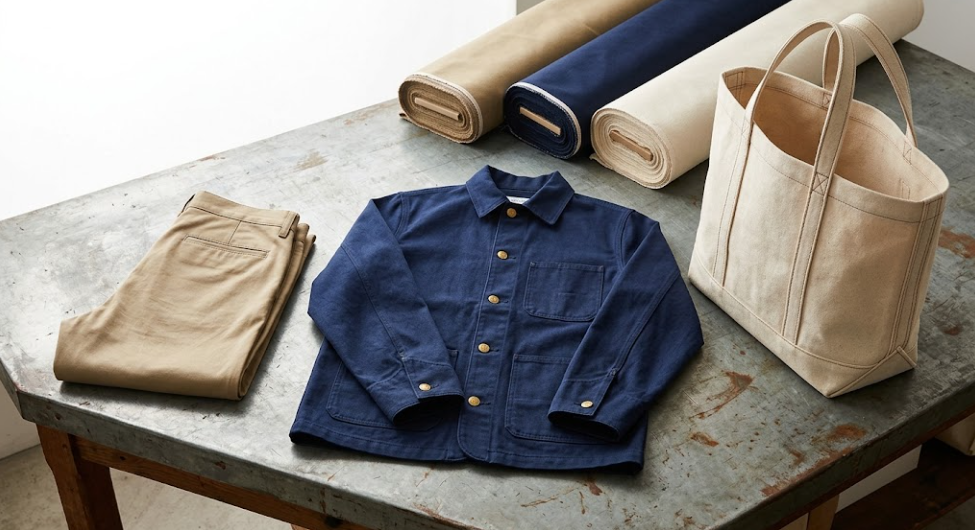
Canvas ETC operates as a wholesale fabric supplier and custom textile-production partner based in the United States. We bridge the gap between material specification and industrial fulfillment, serving independent makers, emerging apparel brands, commercial upholstery manufacturers, and institutional clients.
Our primary manufacturing and sourcing advantages include:
Whether you need 50 yards of 7.5 oz chino twill for an apparel line or full truckload quantities of 12 oz bull denim for contract seating, our textile specialists are available to verify specifications, provide swatch rings, and support your production run. Contact Canvas ETC today to request sample swatches or discuss wholesale pricing for your upcoming program.