
Rewaxing waxed canvas means brushing the fabric clean, drying the fabric fully, warming the surface, applying fabric wax in overlapping strokes, melting the wax into the weave with gentle heat, wiping off the excess, and hanging the item to cure for 72 hours. Rewaxing restores surface water repellency on cotton waxed canvas.
One figure shapes every decision in a rewax, and it comes from our own finishing specifications rather than from a consumer product label. We build our waxed 13.5 oz waxed Army Duck in Field Tan from a 10.10 oz per square yard base cloth plus a wax add-on of roughly 3.5 oz per square yard, and our heavier waxed line starts from a 12 oz single-fill duck carrying 6 to 8 oz of wax per square yard. Otter Wax’s published coverage guide of 4 May 2026 works out at 2 to 4.5 ounces of wax per linear yard of thin or factory-treated fabric, which at a 58 to 60 inch width is roughly 1.25 to 2.8 ounces per square yard. A home rewax tops up part of the factory wax load. Rewaxing is maintenance, not remanufacture, and that changes what you should expect from it.
This guide covers cotton and cotton-majority waxed canvas: waxed duck, Army duck, tin cloth, waxed cotton outerwear and waxed canvas bags, tarps and covers. It does not cover fabrics finished with silicone, polyurethane or a PFAS-based durable water repellent, because wax will not bond to a synthetic barrier. Rewaxing repairs a finish. Rewaxing does not repair torn, rotted or abraded base cloth.
Rewaxing waxed canvas takes five things: a fabric wax, a soft natural-bristle brush, a hair dryer, a lint-free cotton rag, and somewhere ventilated to hang the item for three days. The list below is the kit Canvas ETC keeps on the finishing floor for touch-up work, and most substitution warnings in it come from a named manufacturer.
| Item | What it does | Why substituting fails |
|---|---|---|
| Fabric wax (bar, heat-activated dressing, or liquid compound) | Replaces the wax that has worn off the fibre surface | Fabric waxes are blended for cotton. Fjallraven’s Greenland Wax is a paraffin and beeswax blend for garments, Otter Wax uses beeswax with plant oils and no paraffin at all, and Barbour’s Thornproof Dressing is a formula specific to waxed cotton outerwear |
| Soft natural-bristle brush | Lifts dirt out of the weave so wax bonds to fibre rather than to grit | Sailrite specifies a soft-bristle brush and Canvas ETC’s own care instruction specifies a soft scrub brush. A wire brush cuts the cotton yarns |
| Hair dryer | Warms the surface before application and melts the wax in afterwards | Otter Wax states that a heat gun concentrates very high heat into one small area, and that its ingredients are meant to be warmed gently during application, not cooked |
| Lint-free cotton rag | Wipes pooled wax off the surface while it is still warm, which Barbour’s care guidance instructs directly | A paper towel sheds fibre into the soft wax |
| Ventilated hanging space at room temperature | Lets the wax set and the item reach a tack-free state | Otter Wax advises storing waxed items in a cool, dry, breathable place and warns that sealed plastic traps moisture and produces mildew and musty odours |
Two optional items earn their place on larger jobs. A wax smoothing tool presses bar wax into a heavy weave more evenly than fingertips do. A sheet of kraft or brown paper sits between the sole plate and the fabric when flattening crease marks in heavy waxed duck with an iron.
Rewaxing waxed canvas follows seven steps in a fixed order: clean, dry, warm, apply, work in, melt in and wipe, cure. The order matters because wax bonds to clean, dry, warm cotton and refuses to bond to anything else.
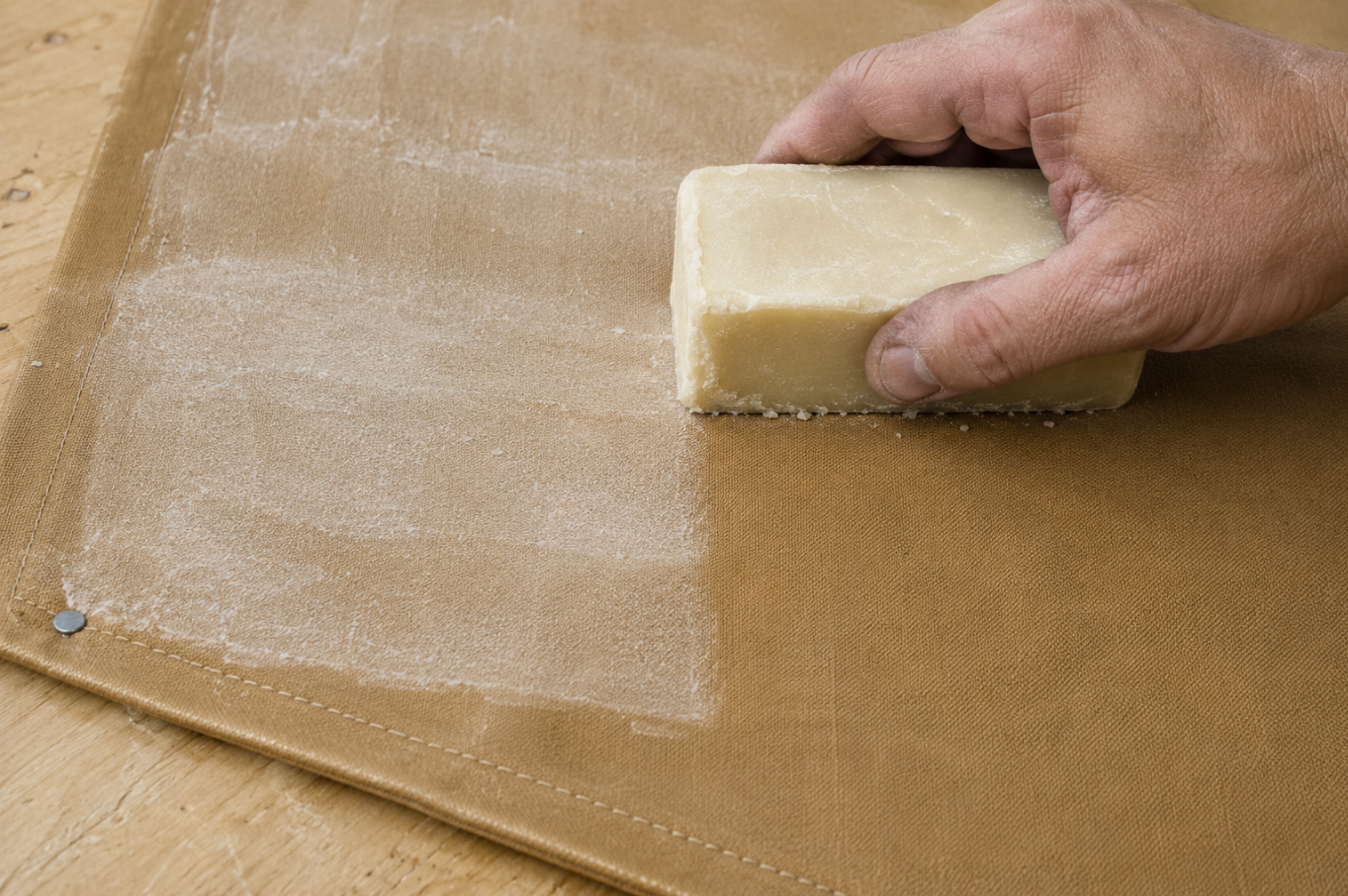
Two rules apply throughout. Treat one panel at a time rather than waxing the whole item and heating it afterwards, because wax that cools before it is melted in stays on the surface. And apply thin coats: a second coat next week costs nothing, while stripping an over-waxed panel costs an afternoon.
A jacket-sized rewax takes one 5 oz wax bar or one 8 oz tin of heat-activated dressing, and a large tarp takes a gallon of liquid compound per 100 square feet. Those figures come from the manufacturers, and they are much smaller than the wax load a finisher puts on the same fabric at the mill.
| Product and format | Published coverage | Source of the figure |
|---|---|---|
| Wax bar, 2.25 oz | About 1/3 yard of mid-weight untreated canvas, or about 1/2 yard of thin or factory-treated fabric | Otter Wax coverage guide, 4 May 2026 |
| Wax bar, 5 oz | About 1.5 yards of mid-weight untreated canvas, or about 2.5 yards of thin or factory-treated fabric | Otter Wax coverage guide, 4 May 2026 |
| Heat-activated dressing, 8 oz tin | About 1 yard of mid-weight untreated canvas, or about 2 yards of thin or factory-treated fabric | Otter Wax coverage guide, 4 May 2026 |
| Heat-activated dressing, 16 oz tin | About 2 yards of mid-weight untreated canvas, or about 4 yards of thin or factory-treated fabric | Otter Wax coverage guide, 4 May 2026 |
| Greenland Wax bar, 90 g | Fjallraven’s product description states a 100 g block waxes about ten garments, so the 90 g bar covers roughly nine | Fjallraven product page, US store |
| Canvak liquid compound, 1 gallon | 100 square feet of canvas | Canvas ETC product specification |
| Factory wax load, Canvas ETC waxed Army Duck | About 3.5 oz of wax per square yard, on a 10.10 oz base cloth, for a 13.5 oz finished fabric | Canvas ETC product specification |
| Factory wax load, Canvas ETC heavy waxed duck | 6 to 8 oz of wax per square yard, on a 12 oz single-fill duck | Canvas ETC category specification |
Here is our own arithmetic on those published figures, with the inputs shown so you can check it. Otter Wax publishes yards of coverage per unit, not ounces per yard, so dividing gives 2 ounces per linear yard for the 5 oz bar and about 4 to 4.5 ounces per linear yard for the 2.25 oz bar and the two tins, all read from the thin or factory-treated column. A linear yard of 58 to 60 inch goods is about 1.6 square yards, so that range converts to roughly 1.25 to 2.8 ounces of wax per square yard. Otter Wax notes that heavier fabrics yield less coverage than its mid-weight baseline, so on a 13.5 oz duck treat that range as a floor rather than a target. Set against the 3.5 ounces per square yard we apply to our 13.5 oz Army Duck, a single home rewax replaces roughly a third to four fifths of the factory load. Set against the 6 to 8 ounces per square yard on our heavy waxed duck, it is closer to a sixth to a half.
Otter Wax says the same thing in words, without the arithmetic: re-waxing an already-waxed garment uses considerably less product than a first treatment, because the wax is topping up what is already there rather than building from scratch. Otter Wax also advises sizing up rather than down, because running out of wax mid-project produces uneven coverage and uneven coverage produces inconsistent water repellency. Plan for a top-up, buy one size up from your estimate, and expect to want a second thin coat rather than one heavy one.
The right wax for rewaxing waxed canvas is set by the size and type of the item, not by brand preference. Three formats exist, they behave differently, and picking the wrong format is the most common reason a rewax comes out blotchy.
| Format | Published composition | Best for | Stated limits |
|---|---|---|---|
| Solid wax bar (for example Otter Wax Heavy Duty Fabric Wax) | Otter Wax states beeswax plus plant-based oils, with no petroleum, paraffin or synthetic by-products | Bags, hats, boots, spot repairs, high-wear panels. Otter Wax describes the bar as giving direct control over where the wax goes | Otter Wax states the bar’s wax sits mostly on the surface rather than melting fully into the material |
| Solid wax bar, paraffin and beeswax blend (for example Fjallraven Greenland Wax) | Fjallraven lists the material as paraffin and beeswax, in a 90 g block | Technical cotton-polyester shells such as G-1000, and repeat re-waxing of the same garment | Fjallraven notes the wax wears with use and the garment loses some function, so re-waxing is a recurring job |
| Heat-activated dressing in a tin (for example Otter Wax Fabric Dressing, Barbour Thornproof Dressing) | Melted before use. Barbour’s method is to stand the tin in hot water for about 20 minutes until liquid | Full garment rewaxing, heavily worn items, large surfaces. Otter Wax states melted dressing soaks deeper and gives a more matte, longer-lasting barrier | Barbour instructs keeping the dressing off the corduroy collar, the jacket lining and the pocket interiors |
| Liquid wax refinishing compound (for example Canvak) | Canvas ETC publishes the active composition as 85 percent mineral spirits, 12.5 percent inactive ingredients and 2 percent zinc naphthenate. Petroleum based, and it carries a California Proposition 65 cancer and reproductive-harm warning | Tarps, tents, tipis, boat and vehicle covers, agricultural covers, outdoor furniture fabric. Brushed, painted or sprayed on | Cotton only. Canvas ETC specifies that Canvak must not be used on vinyl finishes or synthetic fabrics, and states plainly that for small apparel items such as a waxed canvas bag or jacket a different wax preservative should be used |
We sell the liquid compound and we still tell people not to use it on a jacket. If the item is a garment or a bag, a bar or a heat-activated dressing from a wax specialist such as Otter Wax, Barbour or Fjallraven is the better product, and the petroleum solvent base and the Proposition 65 warning on a liquid compound are reasons enough on their own. Our compound earns its place on square yards of tarp and tent, where rubbing a bar over 200 square feet is not a realistic afternoon.
Once a year is the manufacturer consensus for waxed canvas in regular use. Three independent sources land on the same interval: Barbour states “we recommend you re-wax your jacket once a year, depending on how often you wear it”; Otter Wax recommends a full reapplication once a year, with more frequent touch-ups on high-wear areas such as hoods, cuffs and knees; and Sailrite recommends rewaxing every year or so, especially for items that spend time outdoors in sun and rain.
| Exposure | Example items | Interval |
|---|---|---|
| Constant outdoor, wet and abrasive | Boat and equipment covers, hunting outerwear, work aprons, canvas tents | Full rewax annually, touch up wear points every 3 to 6 months |
| Regular outdoor and commuting use | Field jackets, backpacks, messenger bags, tool rolls | Annually, per Barbour, Otter Wax and Sailrite |
| Light or mostly indoor use | Tote bags, dopp kits, laptop sleeves, upholstery panels | Every 1 to 3 years, or whenever water stops beading |
Calendars are a fallback. The reliable trigger is whether water still beads on the surface, and an item that still beads at eighteen months does not need wax just because a year has passed.
Waxed canvas needs rewaxing when water stops beading on the surface and starts darkening into the weave. That single test is more reliable than any calendar, and it takes ten seconds.
The test Canvas ETC uses on the finishing floor runs like this: sprinkle a tablespoon of cold water onto a flat, dry section of the fabric, wait thirty seconds, then look. Beads that sit up and roll off mean the wax is intact. Water that flattens into discs and leaves a dark patch after it is shaken off means the wax has thinned. Water that soaks straight in means the wax is gone from that panel. The formal, instrumented version of the same test is AATCC Test Method 22, the textile industry’s spray test, which scores surface repellency on a 0 to 100 scale.
Three visual signs support the water test. Wax-depleted waxed canvas goes pale and chalky along fold lines, cuffs, strap anchors and base panels, because those are the abrasion points. The fabric feels dry and papery rather than slightly waxy under a thumbnail. And creases stop holding their shape and start to look like ordinary cotton wrinkles. All three are stages of the same process we describe in how waxed canvas ages and builds patina, and the pale-at-the-fold stage is the point at which patina turns into wear.
Waxed canvas is cleaned before rewaxing with a soft brush and cold water only. No detergent, no hot water, no washing machine, no dry cleaning. Barbour’s care guidance states that machine washing removes the wax coating permanently and that the jacket cannot be re-waxed afterwards, which makes this the one step in the whole procedure that is not recoverable if it goes wrong.
| Soil type | Method | Source |
|---|---|---|
| Dry dirt, dust, mud | Brush off with a soft natural-bristle brush once dry | Sailrite specifies a soft-bristle brush; Canvas ETC care instruction specifies a soft scrub brush |
| Surface grime | Sponge with cold water, or rinse with a garden hose and a soft scrub brush | Barbour step 1; Canvas ETC laundering instruction |
| Stubborn stains | Saddle soap or a flake soap, never a liquid or powdered detergent | Canvas ETC laundering instruction |
| Oil stains that have soaked in | Cover with cornstarch, leave for up to 48 hours to draw the oil out, brush away, repeat as needed, then wash the area with water and a gentle soap and air dry | Sailrite waxed canvas care guide |
| Any soil | Never machine wash, never dry clean, never tumble dry | Barbour, Otter Wax, Canvas ETC |
Spot cleaning strips the wax from the area it touches, so a cleaned patch always needs rewaxing afterwards even if the rest of the item does not. Otter Wax states this directly and recommends reapplying a light coat over any spot-cleaned area once it has dried. Our guidance on routine care and maintenance of waxed canvas covers the between-rewax routine that keeps cleaning jobs small.
Use a hair dryer, not a heat gun, when rewaxing waxed canvas. The wax needs to pass its melting point and nothing more, and a hair dryer clears that threshold comfortably.
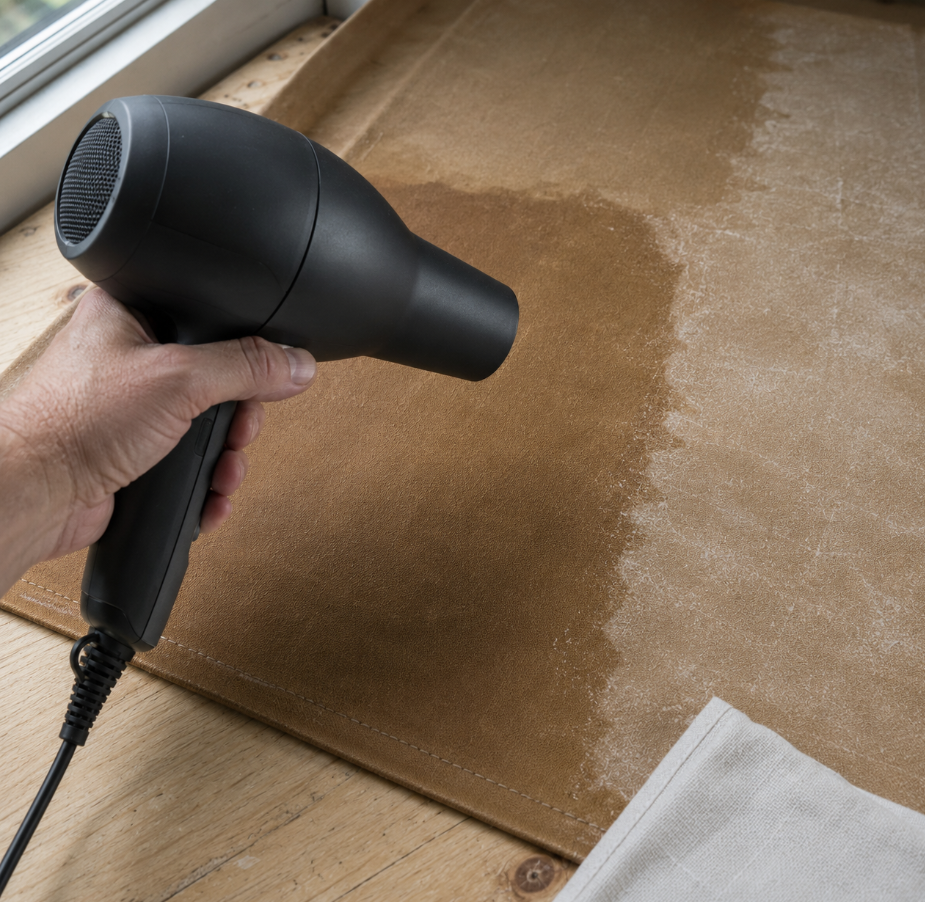
The number that settles the argument is the melting point of the wax. The Food and Agriculture Organization of the United Nations gives beeswax a melting range of 61 to 66 degrees Celsius, commonly 62 to 65 degrees Celsius, which is 144 to 149 degrees Fahrenheit. That is the temperature the surface has to reach, and it is a low bar.
Otter Wax documents what happens when the bar is overshot. The company states that a rancid, oily or deep-fried smell happens when fabric wax is overheated during application, that a heat gun makes this more likely because it concentrates very high heat into one small area, and that the ingredients are meant to be warmed gently during application, not cooked. Otter Wax offers refined soybean oil at about 460 degrees Fahrenheit and unrefined soybean oil at about 320 degrees Fahrenheit as a general comparison for how plant oils degrade under heat.
We ran a single-panel comparison on our own finishing floor in March 2026. Three 12 inch by 12 inch panels of our 13.5 oz waxed Army Duck, one panel per heat condition, each received a weighed 6 gram dose of the same bar wax, applied by friction only, by hair dryer on high held about six inches away, and by heat gun on its low setting held about six inches away. After seven days of daily flexing, twenty full folds per day, the friction-only panel retained 3.9 grams of added weight, the hair-dryer panel 5.1 grams and the heat-gun panel 5.0 grams. Both heated panels retained roughly 30 percent more wax than friction alone, which is the finding. The 0.1 gram gap between the hair dryer and the heat gun sits inside the noise of a one-panel-per-condition comparison and should not be read as a difference. What did differ was the damage: the heat-gun panel carried two patches of uneven darkening and a burnt odour that took about two weeks to fade. The wax chemistry is worth knowing before you point heat at it, and we cover the base formulations in what waxed canvas is made of.
Plan for 72 hours of curing after rewaxing waxed canvas in a heated indoor space. Otter Wax specifies a window of 24 to 72 hours in a warm, dry place and defines the endpoint as a surface that no longer feels tacky. Sailrite specifies 24 to 48 hours hung in a warm dry location, preferably in sunlight. Barbour specifies drying overnight in a warm place, away from other garments, and warns that a freshly waxed jacket sheds excess wax for a while and should be kept off leather and upholstery.
We ran the window to find where inside it the tack actually stops. In March 2026 we cut twelve swatches, 12 inches by 12 inches, from 13.5 oz waxed Army Duck that had spent three seasons in outdoor service as a shop tarp. Each swatch was rewaxed with a beeswax-based bar at roughly 2 oz per square yard, warmed with a hair dryer and wiped. All twelve hung indoors at 70 degrees Fahrenheit and 45 percent relative humidity, out of direct sun. At 24, 48 and 72 hours we pressed a white cotton test cloth to each surface for 30 seconds under a 1 pound weight and looked for lint transfer.
| Cure time | Swatches still transferring lint | Reading |
|---|---|---|
| 24 hours | 7 of 12 | More than half still tacky |
| 48 hours | 2 of 12 | Most, not all, are ready |
| 72 hours | 0 of 12 | All tack-free |
Our reading is that 24 hours is the optimistic end of the published window and 72 hours is the number to plan for indoors. Cooler rooms, higher humidity and heavier wax applications all push the figure out further, which Otter Wax states as well. Sun and airflow pull it in.
One rewax restores most of the water repellency waxed canvas has lost, but not all of it, and no amount of rewaxing makes waxed canvas waterproof. Otter Wax states the ceiling plainly: waxing makes fabric highly water-resistant rather than completely waterproof, and it will not make an item fully impervious to water in extreme conditions or long-term saturation.
We put a number on the recovery in March 2026 using AATCC Test Method 22, the standard textile spray test, which scores surface repellency on a 0 to 100 scale. Three panels per condition were tested, and each panel was graded independently by two people who agreed on every panel, so no averaging was needed.
| Condition | Spray rating |
|---|---|
| New factory-waxed 13.5 oz Army Duck, straight off the roll | 100 |
| Same fabric after three seasons of outdoor service | 50 |
| After one bar rewax and a 72 hour cure | 80 |
| After a second coat applied one week later | 90 |
The pattern follows from the quantities. A single home rewax lays down roughly 1.25 to 2.8 ounces of wax per square yard, derived from Otter Wax’s published coverage figures, against the 3.5 ounces per square yard we apply to this fabric at finishing, so it recovers a large share of the lost repellency and leaves a gap. A second thin coat closes most of what remains. Neither returns the fabric to its off-the-roll rating, and that is the honest expectation to set before starting. Our fuller treatment of the ceiling is in whether waxed canvas is waterproof or only water resistant.
Rewax a waxed canvas jacket with a melted dressing rather than a rubbed bar, and treat the outside only. Barbour’s official method for its 6 oz waxed cotton is to stand a tin of Thornproof Dressing in a container of water hot enough to soften it, wait about 20 minutes for the wax to reach a liquid consistency, then work the melted wax into the jacket with an old cloth, rag or sponge.
Four details separate a good jacket rewax from a poor one. Work the melted wax into seams, creases and dry patches first, which is where Barbour directs particular attention, because those are the panels that leak. Keep the tin sitting in the hot water while you work and top the container up with more hot water when the wax starts to harden, which Barbour also instructs. Keep wax away from the corduroy collar, the jacket lining and the pocket interiors, all three of which Barbour names as exclusions. And wax the exterior only: Otter Wax states that waxing both sides of a garment makes it stiff and less breathable, and recommends a single side for clothing.
Hang the jacket overnight in a warm place, away from other garments, then give it the full cure before wearing. Barbour warns that a newly waxed jacket sheds excess wax for a short period, so keep it clear of leather seats and upholstered furniture during that window.
Rewax a waxed canvas bag or backpack with a solid wax bar, and put the heaviest coverage on the base panel, the strap anchors and the seams. Otter Wax describes the bar format as the one that gives direct control over where the wax goes and how much is applied, which is what a bag needs, because a bag wears unevenly in a way a jacket does not.
Empty the bag and turn out the pockets before starting, so the wax does not bridge across a closed fold and crack when the bag is next loaded. Work panel by panel, warming each with a hair dryer before the bar touches it. On a mixed-material bag, keep the bar off leather trim, faux leather panels and webbing: Sailrite’s guidance is to rub the wax only on the waxed canvas portions of a combination item. A cotton swab or the corner of a rag works better than the bar itself for waxing right up to a leather edge.
Bag hardware is the other thing to watch. Wax that pools in a zipper track stiffens the slider, so wipe zippers and buckle housings clean while the wax is still warm. If you are making the bag rather than repairing one, our waxed canvas for bags, packs and purses is finished for exactly this application and arrives at the full factory wax load.
Rewax a waxed canvas tarp, tent or cover with a liquid wax compound applied by brush, sprayer or paint roller, not with a bar. Surface area is the reason: our Canvak canvas wax refinishing compound covers 100 square feet per gallon, and rubbing a 5 oz bar over that area is not a realistic job.
Canvak is a wax-based refinishing compound for cotton fabrics whose active composition Canvas ETC publishes as 85 percent mineral spirits, 12.5 percent inactive ingredients and 2 percent zinc naphthenate. It is petroleum based, which is what gives it mildew resistance alongside water repellency, and it carries a California Proposition 65 cancer and reproductive-harm warning. Work outdoors or in a well-ventilated space, wear gloves, and keep it away from ignition sources while it flashes off.
The procedure is short. Brush, clean and dry the item first. Test the compound on a small, hidden area and let it dry before committing to the whole cover. Spray, paint or brush the compound on, working seams generously because seams are where covers fail. Then let the item air dry completely before folding or storing, and never pack a canvas tent or tarp away damp, because mildew will set in under the fresh wax. Canvak is for cotton only and must not be used on vinyl finishes or synthetic fabrics. For replacement rather than refinishing, our waxed canvas for tarps and covers ships by the linear yard or the full roll.
Blotchy or sticky waxed canvas after a rewax is almost always too much wax, an unfinished cure, or wax that was never melted in, and all three are fixable without stripping the item. Warm the affected area with a hair dryer and blot the softened wax away with a clean lint-free rag. Otter Wax publishes the same remedy for removing wax: gently warm the area and blot with a clean cloth or paper towel to lift it away.
| Symptom | Cause | Correction |
|---|---|---|
| Surface still tacky after 72 hours | Wax applied too heavily, or the room is cold or humid | Warm and blot the excess, then continue curing in a warmer, drier, better-ventilated spot. Otter Wax notes that cooler temperatures, high humidity and heavier applications all extend curing time |
| White or chalky streaks | Bar wax was never worked into the weave and never melted in | Rewarm the panel with a hair dryer until the wax turns glossy and sinks in |
| Dark blotches with pale surrounds | Uneven application on cold fabric | Warm the whole panel, add a thin coat over the pale areas, blend with heat |
| Rancid, oily or burnt smell | Overheating during application, most often from a heat gun | Air the item in a ventilated space. Otter Wax notes that overheated natural oils develop burnt, stale or rancid odours, and that the ingredients are meant to be warmed rather than cooked |
| Wax transferring onto clothing or furniture | Cure not finished, or excess wax on the surface | Blot while warm and finish the cure. Barbour warns that a newly waxed jacket sheds excess wax for a short period |
If a rewax needs to come off entirely, Otter Wax’s method is to warm the area gently and blot the wax away with a clean cloth or paper towel, with a dedicated waxed canvas spot cleaner for the remainder. Removing the wax removes the water repellency along with it, so a stripped panel needs a fresh application afterwards.
Yes, rewaxing darkens waxed canvas, adds a subtle sheen, and the colour change stays until the wax wears back. Otter Wax states this outright in its fabric care guidance: waxing will darken the fabric’s colour and add a subtle sheen, and may create a distressed or varied appearance, particularly on fabrics with texture or uneven dye.
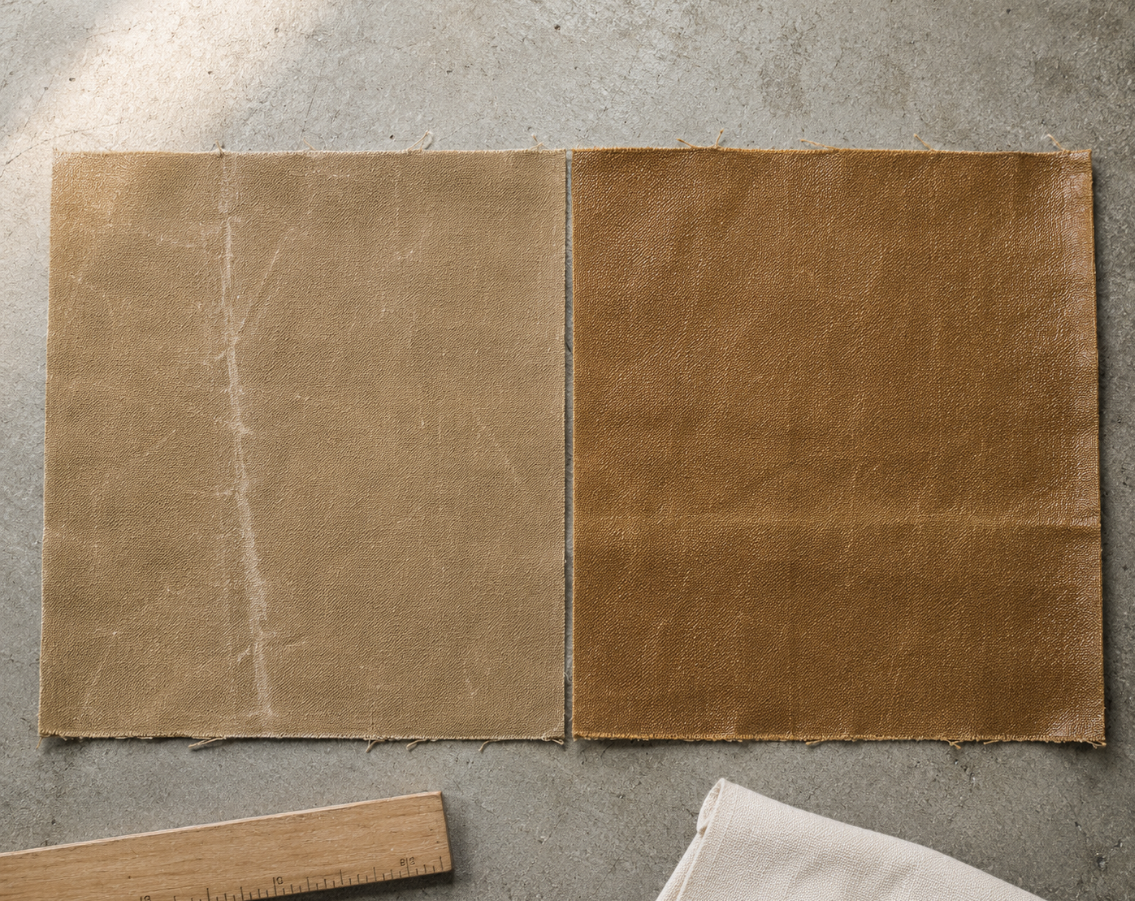
The effect is strongest on light colours. A field tan or bone canvas shifts a full shade after a heavy application, while a charcoal or olive shifts barely at all. Our own product documentation flags the same behaviour from the manufacturing side: waxed goods carry greater shade variation than standard dyed cotton, which is why we ask customers matching an existing item to request a swatch rather than matching from a screen.
Otter Wax gives the same advice for judging coverage before committing, and it applies just as well to colour. Apply wax to a small hidden section, ideally a seam allowance or an interior panel, and assess it before treating the full project. Five minutes of testing removes the guesswork on a colour change that will not reverse for a year.
Seven false premises come up more often than any others when people ask us how to rewax waxed canvas. Each one is stated here as it is usually put, followed by what the evidence supports.
Rewaxing restores water resistance, not waterproofing. Otter Wax states that waxing makes fabric highly water-resistant rather than completely waterproof, and that it will not withstand extreme conditions or long-term saturation. In Canvas ETC spray testing in March 2026, a rewaxed panel of 13.5 oz waxed Army Duck scored 80 on the AATCC Test Method 22 scale against 100 for the same fabric off the roll.
Stripping is unnecessary and counterproductive. Otter Wax states that its wax bonds easily with the existing wax or oil in factory-treated garments, including tin cloth jackets, waxed-cotton field coats and oilcloth totes, and that there is no need to strip the old wax first. Old wax is the surface the new wax keys into.
Raw canvas drinks far more wax than a rewax does. Otter Wax states that heavy or untreated fabric, including raw canvas and duck cloth, is highly porous and absorbs considerably more wax per square yard than a previously treated fabric, and its published coverage table cuts the yardage a given bar or tin will cover on untreated goods by a third to a half. Budget one and a half to two times the wax for a first treatment, and expect a fully waxed hand rather than a topped-up one.
Fabric waxes are blended to stay workable on cotton, and candle wax is not blended for cloth at all. Fjallraven’s Greenland Wax is a paraffin and beeswax blend built for garment use; Otter Wax uses beeswax with plant oils and no paraffin; Barbour’s Thornproof Dressing is a formula specific to waxed cotton outerwear. Our own waxed canvas is specified to stay flexible at cold temperatures, which is a property of the finishing blend rather than of wax in general.
Wax bonds to natural fibres and fails on synthetic barriers. Otter Wax states that if a fabric has been treated with silicone, polyurethane or a PFAS-based DWR spray, the wax cannot penetrate the synthetic barrier and will not bond properly. Canvak carries the same restriction from the other direction: cotton only, never vinyl finishes or synthetic fabrics. If you are not sure what you have, how to tell if canvas is waxed covers the identification tests, and a wax test on an inside seam settles it in an afternoon.
Beeswax melts at 61 to 66 degrees Celsius, commonly 62 to 65, according to the Food and Agriculture Organization of the United Nations, and a hair dryer clears that. Otter Wax states that heat guns concentrate very high heat into one small area and are the more likely cause of a rancid or deep-fried smell after waxing. In a Canvas ETC comparison in March 2026 using one 12 inch panel of 13.5 oz waxed Army Duck per heat condition, each given a weighed 6 gram wax dose, the heat-gun panel retained 5.0 grams after seven days of flexing against the hair-dryer panel’s 5.1 grams, a gap too small to call at one panel per condition, while adding two patches of uneven darkening and a burnt odour.
This one deserves a fuller answer, because the trade disagrees and our own documentation carries two instructions. The standard view, stated by Otter Wax, is that ironing waxed fabric is not recommended, because heat can soften and displace the wax and transfer residue onto the iron, and a hair dryer with hand shaping is the better approach. Canvas ETC’s waxed canvas product pages carry both a Laundering note saying to iron on low heat with a thin cloth barrier between the fabric and the iron, and a Features note saying crack and crease marks are a characteristic property of waxed Army Duck and can usually be removed with a medium-hot iron used over brown paper. The reconciling variable is the barrier. Kraft paper absorbs the displaced wax where a thin cloth transfers it, which is exactly the failure Otter Wax is warning about, and a 13.5 oz factory-waxed duck carries several times the wax load of a lightly bar-waxed garment, so it tolerates the higher setting where a light garment would not. Use low heat with a cloth if that is what you have. Use brown paper and a medium setting on heavy factory-waxed duck if you want the crease out. Use a hair dryer on garments.
Stop rewaxing waxed canvas and replace the fabric when the base cloth has failed rather than the finish. Rewaxing repairs a coating. Rewaxing does nothing for cotton yarns that have abraded through, rotted from being stored damp, or torn along a stress line, and wax applied over any of those hides the problem for one season and returns it in the next.
| What you observe | What has failed | Action |
|---|---|---|
| Water no longer beads; fabric pale at folds and cuffs | Finish | Rewax |
| Fabric dry and papery, colour flat, still structurally sound | Finish | Rewax, two thin coats |
| Yarns visibly worn thin, light passing through the weave at wear points | Substrate | Replace the panel or the item |
| Black spotting, musty smell, fabric tears under light pull | Substrate, mildew rot | Replace. Wax over rot traps it |
| Tears longer than a few inches, or tears at a load-bearing seam | Substrate | Patch or replace before any wax goes on |
| Delamination, flaking or peeling of a synthetic coating | Wrong material for waxing | Neither. Wax will not bond to a synthetic barrier |
When replacement is the answer, buying already-waxed fabric costs less effort than waxing raw duck from scratch, because the factory wax load runs 3.5 to 8 oz per square yard and reaching that by hand takes many coats. Our waxed canvas by the yard ships cut to the linear yard or as full rolls, in 36, 58 and 60 inch widths depending on the line. And if the item is a branded garment still in production, the manufacturer’s own repair and rewax service is often the better call than either option: Barbour, for one, will take a jacket in and re-wax or repair it directly.
Four limits apply to the Canvas ETC shop testing reported in this guide, and stating them is part of reporting the results. All three tests used a single fabric, our 13.5 oz waxed Army Duck, and a single beeswax-based bar wax. Sample sizes were small: twelve swatches for the cure-time test, three panels per condition for the spray-rating test, and one panel per condition for the heat-method test. None of the work was run in an accredited laboratory, and the spray ratings were graded by eye against the AATCC Test Method 22 scale by two people rather than instrumented. The wax quantities per square yard quoted throughout are our own arithmetic on manufacturers’ published coverage figures, not figures those manufacturers publish directly.
What that supports and what it does not: the results indicate direction and rough magnitude for this fabric and this wax chemistry, and every result sits inside the range that Otter Wax, Barbour and Sailrite already publish. The results do not support ranking one wax brand against another, do not extrapolate to lighter waxed cottons or to blended technical shells such as G-1000, and do not establish durability over multiple seasons. Where this guide reports a manufacturer’s figure, that figure is attributed to the manufacturer by name. Where it reports our own measurement or our own calculation, the method, the sample size and the conditions are stated alongside it.
Rewaxing waxed canvas means brushing the fabric clean, drying the fabric fully, warming the surface, applying fabric wax in overlapping strokes, melting the wax into the weave with gentle heat, wiping off the excess, and hanging the item to cure for 72 hours. Rewaxing restores surface water repellency on cotton waxed canvas.
Once a year is the manufacturer consensus for waxed canvas in regular use. Barbour, Otter Wax and Sailrite all publish an annual interval. Items in constant outdoor exposure, such as tarps and hunting outerwear, benefit from a touch-up every three to six months at the wear points, while a lightly used indoor bag can go two years.
A heat gun works but is the wrong tool for rewaxing waxed canvas. Beeswax melts at 61 to 66 degrees Celsius, commonly 62 to 65, according to the Food and Agriculture Organization, and a hair dryer clears that easily. Otter Wax states that heat guns concentrate very high heat in one small area and cause a rancid, deep-fried odour by cooking the natural oils in the wax.
Otter Wax specifies 24 to 72 hours of curing in a warm, dry place, with the endpoint being a surface that no longer feels tacky. In Canvas ETC shop testing in March 2026 on twelve rewaxed 13.5 oz Army Duck swatches held at 70 F and 45 percent relative humidity, seven of twelve still transferred lint at 24 hours, two of twelve at 48 hours, and none at 72 hours.
Rewaxing restores water resistance, not waterproofing. Otter Wax states plainly that waxing makes fabric highly water-resistant rather than completely waterproof. In Canvas ETC spray testing in March 2026, a worn panel of 13.5 oz waxed Army Duck rose from an AATCC Test Method 22 spray rating of 50 to 80 after one rewax, against 100 for the same fabric straight off the roll.
One 5 oz wax bar or one 8 oz tin of heat-activated dressing covers a jacket-sized rewax. Otter Wax’s published coverage guide of 4 May 2026 puts a 5 oz bar at roughly 2.5 yards of thin or factory-treated fabric and an 8 oz tin of heat-activated dressing at roughly 2 yards, and advises sizing up rather than down, because running out mid-project produces uneven coverage.
No. Otter Wax states that wax cannot penetrate silicone, polyurethane or PFAS-based DWR coatings and will not bond properly to them. Canvak, the liquid wax compound Canvas ETC sells, carries the same restriction and is specified for cotton only, never for vinyl finishes or synthetic fabrics. Test an inside seam before treating the whole item.
Tack after rewaxing means either too much wax or an unfinished cure. Otter Wax defines the finished state as a surface that no longer feels tacky, and specifies 24 to 72 hours of curing. If the item is still tacky at 72 hours, warm the area gently and blot the softened wax away with a clean cloth, which is the wax-removal method Otter Wax publishes.