
To wash and preshrink 100% cotton duck canvas, first secure all raw cut edges with a 4-thread overlock serging stitch or wide 3-step zigzag stitch to prevent unraveling. Wash the yardage in warm water at 100°F to 105°F (38°C to 40°C) on a gentle cycle using maximum water volume and a mild, pH-neutral liquid detergent. Tumble dry on medium heat until the fabric is approximately 10% to 15% damp, then immediately remove, pull along the bias to square the grain, and lay flat to finish air drying before pressing with a heavy steam iron.
| Operational Variable | Recommended Workshop Parameter | Critical Failure Mode to Avoid |
|---|---|---|
| Water Temperature | Warm: 100°F to 105°F (38°C to 40°C) for dyed; Hot: 120°F to 130°F (49°C to 54°C) for natural greige | Water exceeding 110°F on dyed duck causes severe dye bleeding and surface mottling |
| Cycle & Water Volume | Gentle, “Bulky”, or “Deep Fill” cycle with maximum water-to-fabric ratio | Low-water eco settings cause heavy localized friction and white crease marks |
| Extraction Spin Speed | Low Spin: restricted strictly to 400 to 600 RPM | Centrifugal force above 800 RPM crushes starched fibers, creating irreversible “crazing” |
| Drying Termination | Tumble dry medium until 10% to 15% damp; complete air drying flat | Bone-dry high heat baking sets stubborn creases that resist even industrial pressing |
| Raw Edge Security | 4-thread overlock serge or 3-step zigzag 0.5 inches inside raw ends | Unsecured cut edges unravel up to 2 inches, tangling into a destructive bird’s nest |
| Observed Shrinkage | Anisotropic: 8% to 12% Lengthwise (Warp) vs. 2% to 5% Crosswise (Weft) | Assuming uniform shrinkage distorts pattern geometry and causes assembly mismatch |
CRITICAL SAFETY WARNING: NEVER MACHINE WASH WAXED CANVAS
This washing and preshrinking protocol applies exclusively to untreated natural and dyed 100% cotton duck canvas. Never place waxed canvas into a washing machine, never submerge it in warm or hot water, and never apply liquid laundry detergents. Water agitation and surfactants permanently liquefy and strip the proprietary paraffin and beeswax finish, leaving blotchy discolored streaks and destroying water repellency. For waxed fabrics, spot clean only using cold water and a soft horsehair brush.
At Canvas ETC, our commercial cutting room and textile testing facilities handle hundreds of thousands of yards of cotton canvas every year. The single most expensive mistake we see makers, designers, and small-batch manufacturers make is cutting pattern pieces directly from raw, unwashed yardage.
Cotton duck is a high-density, plain-woven textile composed of natural cellulosic fibers. During manufacturing, these yarns are held under massive mechanical tension on industrial weaving looms while being coated with sizing starches to withstand abrasion. When raw cotton canvas meets water and thermal agitation for the first time, two irreversible physical transformations occur:
If you skip preshrinking and assemble a tote bag, tailored jacket, utility apron, or upholstery slipcover from unwashed canvas, that dimensional contraction will take place during the finished product’s first domestic cleaning. The consequences are catastrophic:
Preshrinking yardage before laying down your pattern pieces guarantees that 85% to 90% of total lifetime relaxation shrinkage is fully exhausted in advance.
Because duck canvas loses substantial linear length during wet laundering, ordering the exact finished yardage required for your pattern will leave you short. To guarantee adequate material after laundering and grain squaring, we apply our standard commercial purchasing formula:
L_purchased = L_required × 1.12
Where L_required represents the net pattern yardage specified in your design cutting layout. The 1.12 multiplier adds a 12% linear buffer: 8% to 10% to accommodate lengthwise warp contraction, plus 2% to 4% for trimming serged edges and re-squaring the grain line perpendicular to the selvage.
For example, if your slipcover project demands 14 net yards of canvas:
L_purchased = 14 × 1.12 = 15.68 linear yards
In this scenario, purchasing 16 yards provides the necessary margin for a stress-free production run.
To understand how to control duck canvas during laundering, one must understand its microscopic and structural architecture. Duck canvas is not an isotropic material; it behaves completely differently along its lengthwise grain compared to its crosswise grain.
Every roll of woven canvas consists of two intersecting yarn systems:
Because warp yarns absorb the vast majority of mechanical elongation during weaving, they store high elastic strain energy. When submerged in warm water, the amorphous cellulose polymers relax, and the crimp frequency increases dramatically. Consequently, duck canvas shrinks two to four times more in the lengthwise warp direction than it does in the crosswise weft direction.
Understanding this anisotropic reality is critical for pattern drafting. When laying out patterns on preshrunk canvas, always align pattern length with the lengthwise grain line, knowing that any residual shift will remain stable. To learn more about how yarn structures influence fabric behavior, explore our comprehensive technical guide on single-fill versus double-fill duck canvas weave construction.
Warp (Lengthwise): -8% to -12% Shrinkage High loom tension released Weft (Width): -2% to -5% Shrinkage Cotton Duck Bolt Pre-wash Loom State vs. Post-wash Relaxed Figure 1: Anisotropic shrinkage dynamics in cotton duck canvas. Lengthwise warp yarns contract significantly more than crosswise weft yarns due to released loom tension.
To eliminate guesswork for our customers, our textile specialists performed controlled laundering trials across four popular canvas weights following AATCC Test Method 135 (Dimensional Changes of Fabrics after Home Laundering).
Each specimen was laundered under standardized agitation conditions, tumble dried on medium heat until 15% residual moisture remained, and measured across five calibrated gauge points along both the warp and weft axes.
| Canvas Grade | Nominal Weight | Weave Architecture | Water Temp (°F / °C) | Lengthwise Warp Shrinkage (%) | Crosswise Weft Shrinkage (%) | Warp : Weft Ratio |
|---|---|---|---|---|---|---|
| 7 oz Utility Duck | 7.0 oz/yd² (237 GSM) | Single-Fill (1×1) | Cold: 85°F / 29°C Warm: 105°F / 40°C Hot: 130°F / 54°C | 9.2% 10.4% 11.5% | 2.4% 3.1% 3.8% | 3.8 : 1 3.4 : 1 3.0 : 1 |
| 10 oz Army Duck | 10.0 oz/yd² (339 GSM) | Plied Yarns (2×1) | Cold: 85°F / 29°C Warm: 105°F / 40°C Hot: 130°F / 54°C | 8.5% 9.8% 11.2% | 2.1% 2.7% 3.4% | 4.0 : 1 3.6 : 1 3.3 : 1 |
| #10 Numbered Duck | 14.75 oz/yd² (500 GSM) | Double-Fill (2×2) | Cold: 85°F / 29°C Warm: 105°F / 40°C Hot: 130°F / 54°C | 7.8% 8.9% 10.1% | 1.8% 2.4% 2.9% | 4.3 : 1 3.7 : 1 3.5 : 1 |
| #8 Numbered Duck | 18.0 oz/yd² (610 GSM) | Heavy Double-Fill (3×2) | Cold: 85°F / 29°C Warm: 105°F / 40°C Hot: 130°F / 54°C | 6.4% 7.6% 8.8% | 1.4% 2.0% 2.5% | 4.6 : 1 3.8 : 1 3.5 : 1 |
Before loading canvas into a domestic washing machine, you must evaluate equipment capacity and physical fabric handling. Laundering heavy cotton duck creates extreme mechanical stresses that can ruin both the fabric and the appliance.
Unwashed cotton duck is exceptionally absorbent. When submerged, natural cotton cellulose fibers take on between 150% and 220% of their dry weight in water.
A standard 4.5 cubic foot residential washing machine is calibrated to spin light apparel loads weighing between 12 and 16 pounds. Consider the wet physics of heavy canvas:
| Fabric Grade & Weight | Max Domestic Machine Yardage | Recommended Washing Alternative |
|---|---|---|
| 7 oz Utility Duck | Up to 6 yards | Standard residential machine or commercial laundromat |
| 10 oz Army Duck | Up to 4 yards | Front-load gentle cycle or large utility sink |
| #10 Duck (14.75 oz) | Up to 3 yards | Bulky cycle or clean bathtub soak |
| #8 Duck (18.0 oz) | Up to 2 yards | Clean bathtub soak or industrial wash wheel |
| #4 Heavy Duck (24 oz) | 0 yards (Strictly Prohibited) | Dedicated bathtub or deep wash trough soak |
The single most frequent troubleshooting inquiry we receive involves “crazing” or “marring”, the appearance of stubborn white, marble-like crease lines across the surface of dyed canvas after washing.
Amateur blogs mistakenly claim these white streaks are caused by undissolved detergent. In our testing laboratory, microscopic analysis proves that crazing is purely mechanical. Dyed cotton duck canvas is stiffened with mill starches and surface pigment resins. When wadded loosely into a machine drum and spun at high speeds, the rigid fabric folds sharply against itself under centrifugal force. The friction shears off the surface dye along the fold apex, exposing the un-dyed white cotton yarn cores beneath. Once these white lines form, they are permanent and cannot be ironed out.
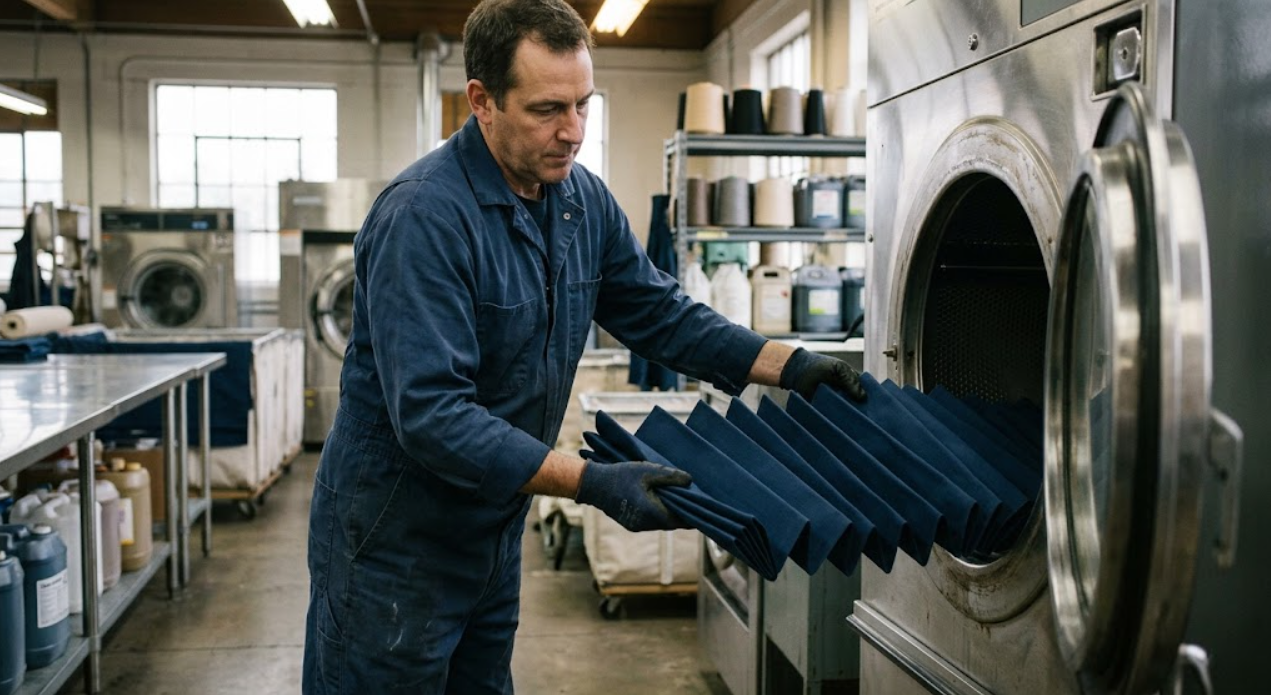
12″ to 16″ Loose PleatsContinuous Accordion Fan-Fold Layout Figure 2: Accordion-folding yardage into loose 12 to 16 inch pleats prior to drum loading ensures unobstructed water circulation and eliminates white stress creasing on dyed duck cloth.
To guarantee a completely crazing-free wash on dyed duck, follow our Four Rules of Anti-Crazing Geometry:
Follow this step-by-step sequence in your workshop to achieve complete dimensional stability and a clean, unblemished finish.
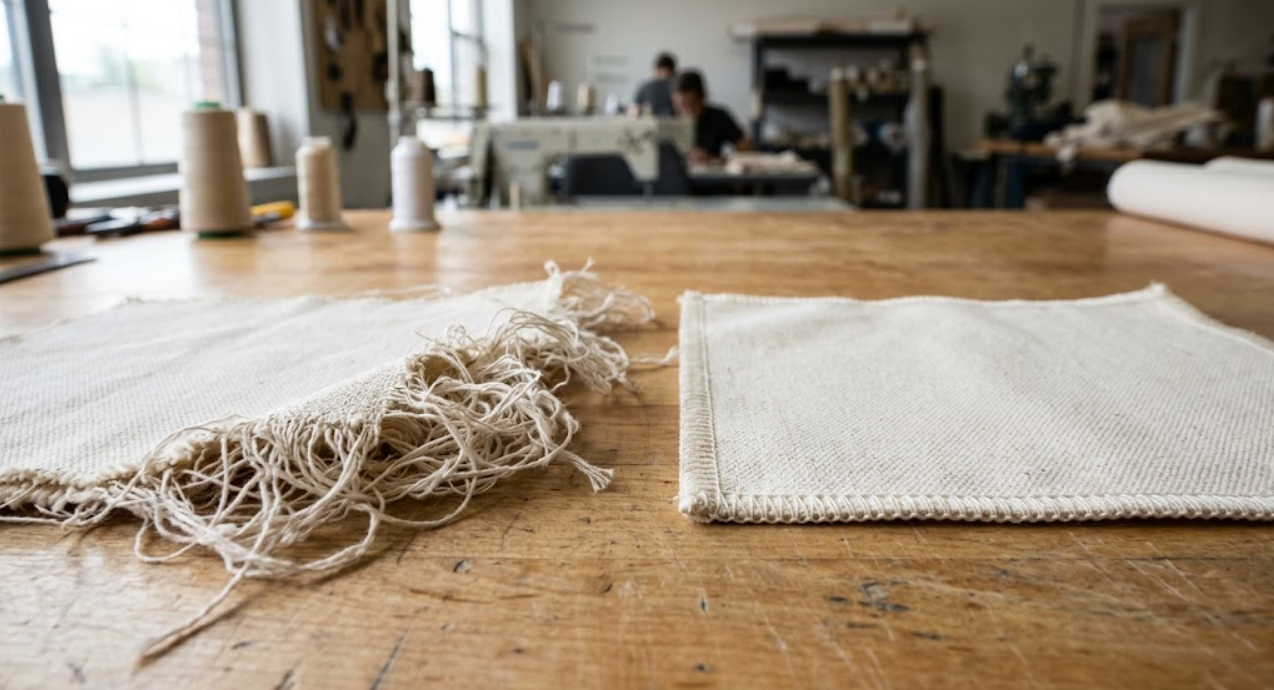
Before cotton canvas touches water, you must secure every cut raw edge across the width of the bolt. Unfinished raw canvas edges will unravel vigorously under wet mechanical agitation, shedding loose yarns that knot around the yardage, forming an unsalvageable bird’s nest.
Do not bunch or coil the fabric. Lay the yardage flat on a clean cutting table and fold it back and forth like a paper fan into loose pleats 12 to 16 inches wide.
Add a modest amount of mild liquid detergent (approximately half the quantity used for standard laundry loads) to prevent excessive foaming and difficult rinsing.
Drying is where the physical contraction of relaxation shrinkage locks into place. However, baking heavy duck canvas until it is bone dry in a hot tumble dryer is a severe mistake that cements deep wrinkles into the heavy fibers.
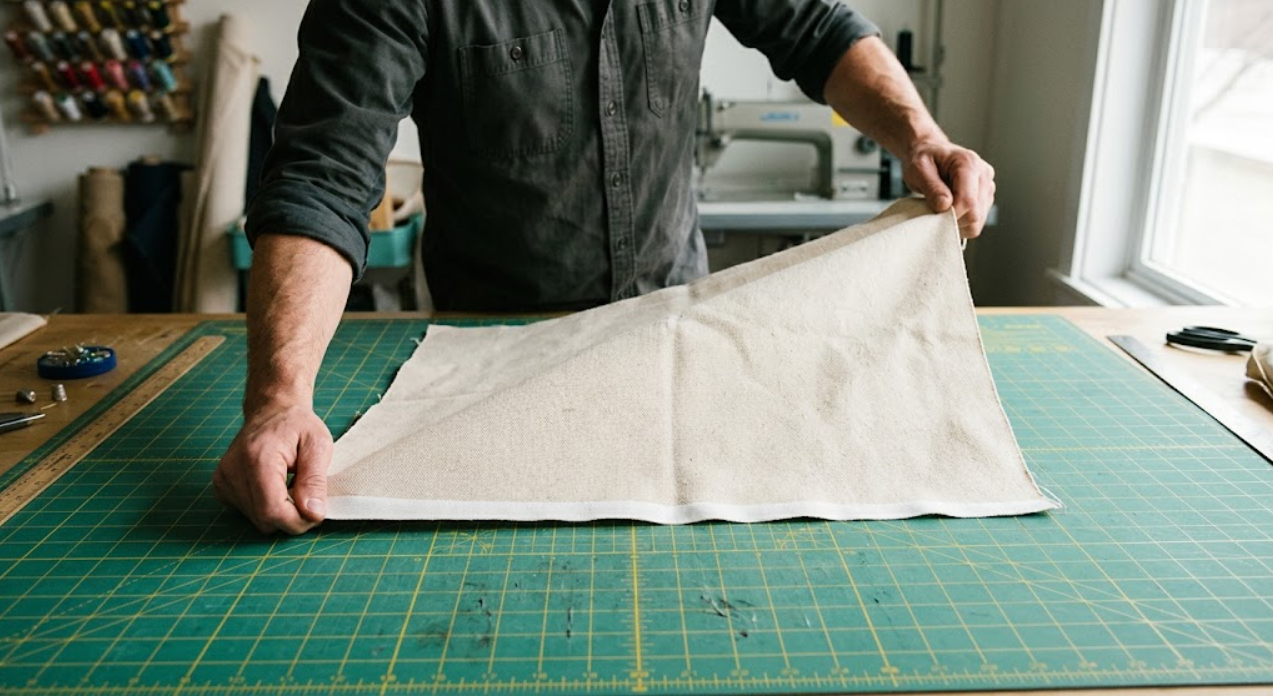
Immediately upon removing the damp canvas from the dryer or drying rack, spread it out across a large, flat cutting table.
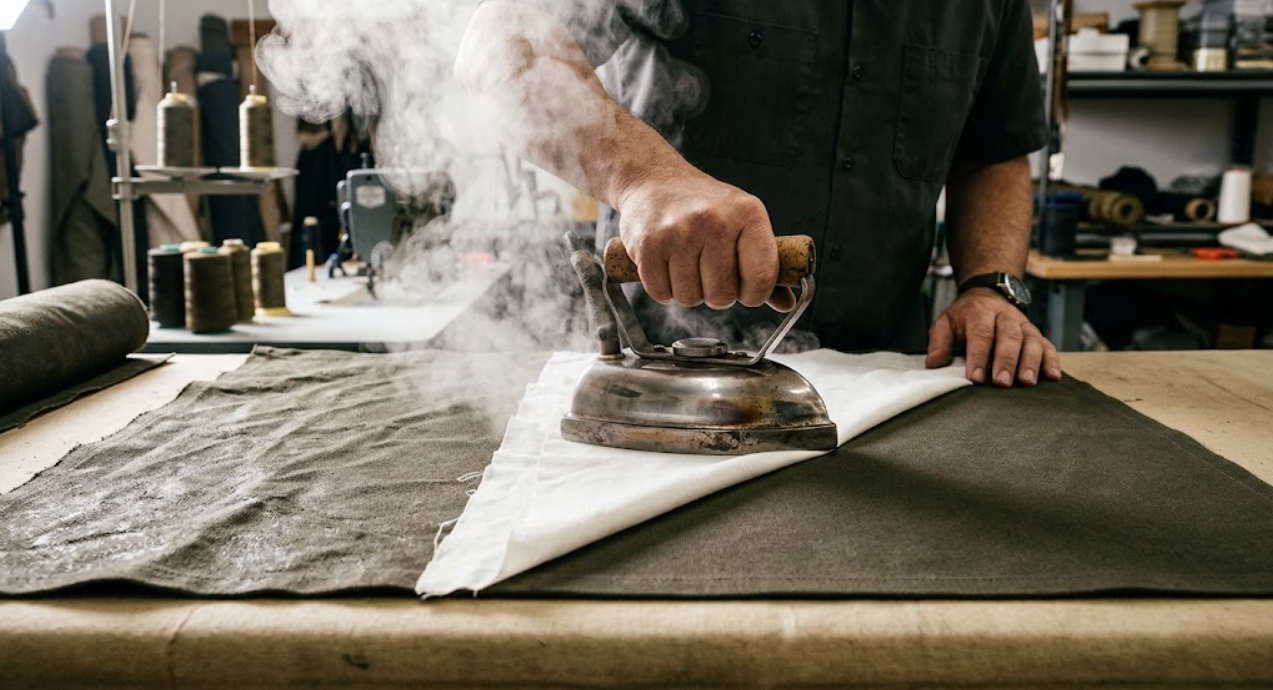
With the canvas still slightly damp, press the entire yardage using a heavy iron on the highest cotton/linen heat setting with maximum steam delivery.
Not all cotton duck fabrics respond identically to laundering. Adjust your workshop approach based on the specific ounce weight and construction of your canvas:
Lightweight canvas, such as our single-fill 7 oz cotton canvas, features single yarns in both warp and weft. These fabrics are supple, highly pliable, and saturate quickly.
Our tightly woven 10 oz army duck canvas and #10 cotton duck canvas represent the industry gold standard for durable work gear. Numbered #10 duck features plied yarns that create a tight, smooth, wind-resistant surface.
Heavy industrial canvas, including our heavyweight #8 duck cloth and ultra-dense 24 oz #4 heavy canvas, is manufactured with thick plied yarns engineered for extreme tensile strength.
While 100% natural cotton duck thrives under wet laundering, coated and synthetic fabrics require completely different care protocols:
Yes, you should always wash and preshrink 100% cotton duck canvas before cutting pattern pieces. Raw canvas contains significant loom tension that releases during the first wash, causing 8% to 12% shrinkage along the lengthwise grain. If you assemble an item from unwashed canvas and wash it later, the uneven shrinkage will cause puckered seams, distorted zippers, and altered finished dimensions.
Under standard warm washing and medium tumble drying, cotton duck canvas shrinks anisotropically: losing 8% to 12% in length (warp direction) and 2% to 5% in width (weft direction). Lighter utility ducks (7 oz and 10 oz) experience slightly higher warp contraction than dense, heavy numbered ducks (#8 and #4). Always plan for this directional variation by multiplying required yardage by 1.12.
To prevent permanent white fold marks (known as crazing or marring), fold the yardage into loose accordion pleats before placing it in the washing machine, select a high water volume cycle (such as “Bulky” or “Deep Fill”), use a mild liquid detergent free of optical brighteners, and restrict spin speed to 400 to 600 RPM. Never wash heavy canvas crumpled tightly or allow it to spin at high speeds exceeding 800 RPM.
We strongly advise against laundering more than 2 yards of #8 duck (18 oz) or any amount of #4 duck (24 oz) in a residential washing machine. Heavy canvas absorbs over 200% of its dry weight in water; a saturated cut of #4 canvas can weigh 20 to 25 pounds, causing drum imbalance, motor strain, and severe crease marring. Heavy numbered canvas is best preshrunk in a bathtub or deep utility soaking basin.
No. You should remove duck canvas from the dryer while it is still 10% to 15% damp. If you allow heavy cotton canvas to tumble dry to bone dryness, the heat cements severe wrinkles into the stiff fibers that are difficult to iron out. Removing it while slightly damp allows you to square the grain by pulling along the bias and steam press the fabric perfectly flat on your cutting table.
Canvas ETC is a leading wholesale fabric supplier and custom textile-production partner based in the United States, specializing in cotton duck canvas, numbered duck, waxed textiles, marine fabrics, technical denier synthetics, and digital fabric printing. Our commercial cutting room, slitting facility, and contract sewing operations serve makers, independent brands, military contractors, and institutional manufacturers worldwide.
Referenced Standards: ASTM D230 (Numbered Duck & Army Duck), ASTM D3776 (Fabric Mass Per Unit Area), AATCC Test Method 135 (Dimensional Changes in Home Laundering), Federal Specification CCC-C-419G.