
Selecting the proper weight of burlap for upholstery backing & rustic home projects is required to guarantee structural durability and an odor-free indoor environment. Traditional furniture restoration demands a heavy ten-ounce utility grade to protect padding from steel coil friction. Decorative crafts require specialized sanitized fabrics to prevent industrial processing odors inside residential spaces. We provide both standard raw rolls and scoured, chemical-free options to meet these technical requirements.
| Project Type | Recommended Weight | Required Finish | DTC Sample Selection |
|---|---|---|---|
| Traditional Cushion Spring Backing | 10 oz per square yard (340 GSM) | Raw Heavy-Duty Utility Finish | printed fabric swatches |
| Indoor Crafts & Table Runners | 10 oz per square yard (340 GSM) | Sanitized Hydrocarbon-Free Scoured Finish | printed fabric swatches |
| Under-Seat Dust Cover Alternative | 1.5 oz Spunbond Polypropylene | Synthetic Nonwoven Barrier | nonwoven dust cover fabric |
| Premium Frame Wrapping Option | 10 oz per square yard Canvas | 100% Cotton Duck Plain Weave | 10 oz cotton canvas duck |
Jute upholstery burlap is a structural backing material by anchoring the coarse plain weave over coiled steel springs to protect upper padding. The dense ten-ounce fabric establishes a protective friction barrier, preventing polyurethane foam migration. Heavy jute fibers guarantee long-term dimensional stability for traditional furniture frames.
Standard coiled steel spring systems generate heavy physical abrasion against padding materials during daily compression. Raw 7 oz craft burlap lacks the weave density to resist spring wire wear, resulting in quick puncture and structural collapse. High-density 10 oz burlap (340 GSM) possesses the mandatory tensile breaking strength, averaging 220 pounds warp strength based on ASTM D5034 testing standards, to support heavy horsehair, cotton batting, or foam padding layers. This heavy canvas barrier distributes localized spring pressure across the entire frame, extending the lifespan of the seat cushion.
We construct traditional upholstery seats by following a strict spatial sequence to balance mechanical tension. First, secure heavy jute webbing to the bottom of the wooden frame and tie the coil springs using high-strength upholstery twine. Next, lay the 10 oz burlap directly over the tied springs, allowing a 2-inch margin on all sides. Tack the jute borders tightly to the wood frame edges, folding the margins over to form a robust, double-thick visual seam. Finally, stitch the burlap directly to the top loops of the springs using a curved needle and upholstery twine to lock the coils in place before applying padding layers.
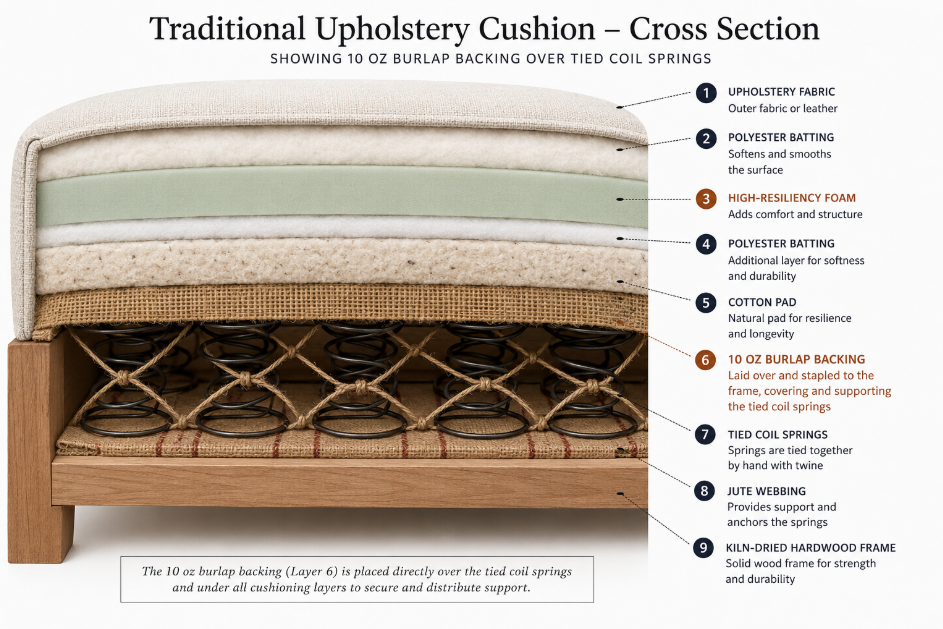
Figure 1: Cross-sectional diagram of traditional upholstery cushion layers, showing the exact spatial placement of the 10 oz burlap backing over tied coil springs. This physical sequence is detailed in the step-by-step instructions.
Sanitized jute burlap is an odorless craft textile by scouring the raw plain weave in high-temperature water to extract volatile hydrocarbon batching lubricants. A clean industrial wash eliminates petroleum residues without weakening natural cellulose plant walls. Scoured fibers dry completely odorless, creating a safe surface for indoor residential crafts.
Industrial jute processing utilizes raw hydrocarbon oils to lubricate coarse plant fibers during mechanical carding. These carding lubricants, commonly known as batching oils, protect the fibers from breaking on spinning machinery. However, these petroleum-based lubricants remain trapped inside the cell walls of raw burlap, releasing a persistent chemical scent that triggers indoor air quality concerns and skin sensitivities. To compare natural fibers and weave classifications, designers can read our analysis of burlap vs hessian vs jute.
High-heat scouring is the only process that extracts industrial batching lubricants completely. At the mill, the raw woven jute undergoes high-temperature alkaline scouring baths (95°C) to break down and flush out mineral oil residues. We provide this sanitized scoured burlap to guarantee craft designers receive completely odorless fabric for home projects.
+--------------------------------------------------------------+
| WARNING: DOMESTIC LAUNDRY SYSTEM RISK |
| |
| Do not launder raw jute burlap in standard household |
| appliances. Jute fibers shed massive volumes of loose |
| lint when saturated. This dense debris will clog domestic |
| drainage lines, block plumbing traps, and damage electric |
| washing machine pumps. Vacuum or hand-wipe raw jute only. |
+--------------------------------------------------------------+
Nonwoven dust cover fabric is a synthetic upholstery backing by applying spunbond polypropylene layers beneath furniture springs to prevent dust accumulation. The clean engineered sheet offers uniform tensile strength, resisting mechanical sagging over decades. Non-allergenic synthetic polymers eliminate organic dust breakdown, providing a clean workspace for modern upholsterers.
Synthetic backing, such as nonwoven dust cover fabric, is an excellent alternative for dust-free, non-allergenic furniture construction. Unlike organic jute, which slowly sheds fine brown dust as the plant fibers age, spunbond polypropylene does not disintegrate into organic particulate matter. We recommend this synthetic cambric for the underside of sofa frames to block pests and seal spring cavities.
For high-end upholstery restoration and premium frame wrapping, a clean tight-weave like 10 oz cotton canvas duck is highly recommended. Cotton canvas offers a smooth, uniform surface that prevents fiber telegraphing through thin outer cover fabrics. To evaluate how cotton compares to traditional structural burlap, you can check our analysis of cotton duck for upholstery.
No. Laundering raw burlap in standard household appliances is not recommended because the process releases large volumes of loose lint. This dense debris will clog domestic drainage lines and plumbing traps. Additionally, the aggressive mechanical agitation unravels the loose plain weave, causing severe material fraying and destroying the fabric structure.
Raw burlap smells like petroleum because industrial manufacturing carding processes apply mineral carding lubricants, known as batching oils, to the raw jute fibers. These oils protect the coarse fibers from breaking on carding machinery during high-speed spinning. The oils remain trapped inside the cell walls, releasing a persistent chemical scent until the textile undergoes industrial scouring.
Burlap, hessian, and jute represent different stages and geographic terms for the same base material. Jute refers to the raw plant fiber harvested from the Corchorus plant genus. Hessian is the traditional British and European term for the resulting plain-weave fabric. Burlap is the standard North American term used to describe the exact same coarse jute weave.