
Ballistic nylon is a high-tenacity synthetic textile woven in a balanced 2×2 basket weave, where denier measures individual yarn mass density in grams per 9,000 meters. Comparing standard specifications, 1050D Nylon 6,6 delivers the highest tear propagation resistance (138 lbf under ASTM D1424) for mission-critical tactical gear; commercial 1680D Nylon 6 provides maximum structural bulk and flat-surface abrasion resistance for heavy luggage; and 840D Junior Ballistic reduces fabric weight by 27% (10.2 oz/yd²) while retaining 425 lbf tensile strength for active carry bags.
At Canvas ETC, we supply specification-grade technical textiles, mil-spec synthetics, and heritage canvas to commercial manufacturers, tactical gear makers, luggage brands, and custom fabricators across the United States. We engineered this comprehensive comparative guide to resolve the material science, physical test benchmarks, polymer chemistry, and shop-floor fabrication realities across 1050D, 1680D, and 840D ballistic nylon yardage. For an exhaustive foundation on this material class, explore our comprehensive guide to ballistic nylon.
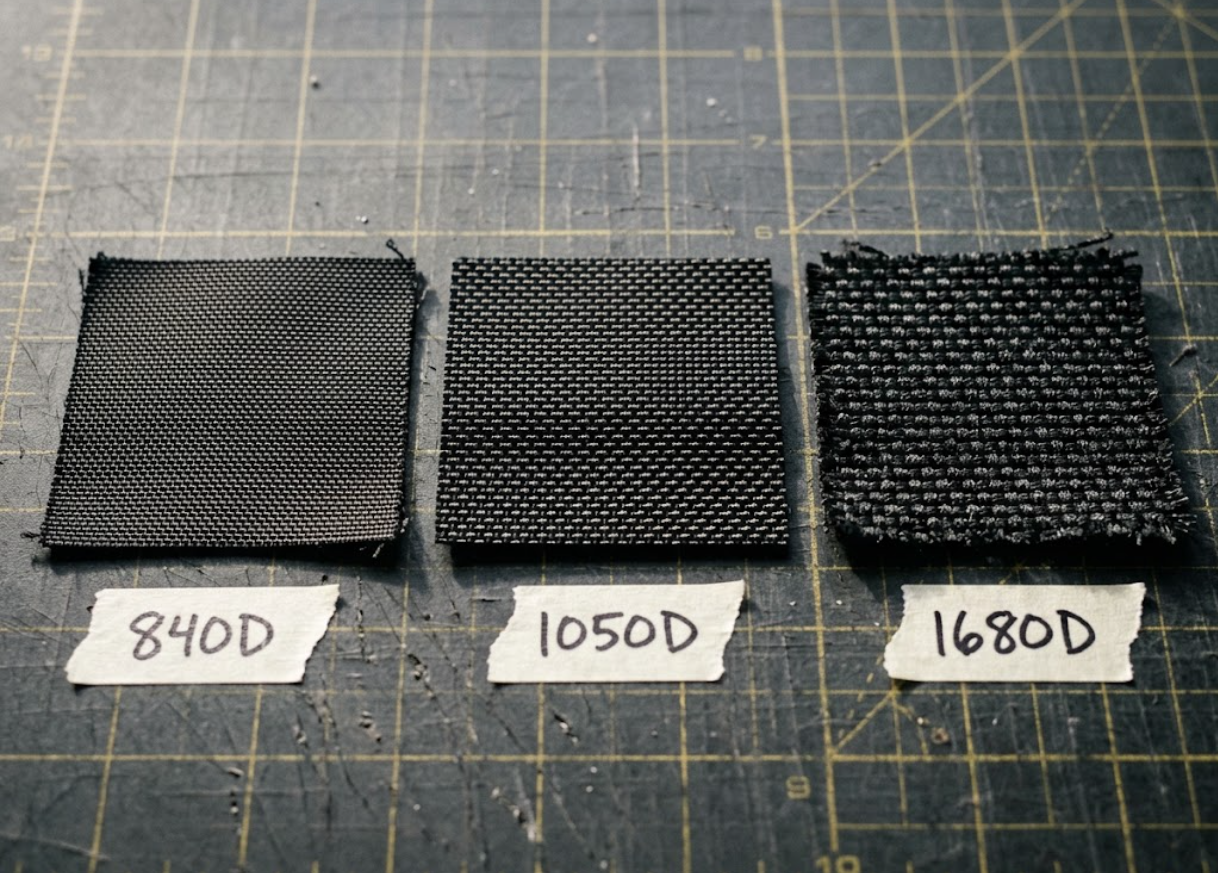
Denier is a unit of linear mass density that measures the weight in grams of 9,000 meters of an individual yarn filament or yarn bundle. Denier measures single-strand yarn thickness rather than finished fabric weight; total finished fabric mass depends on weave density, yarn ply bundling, and protective back-coatings, yielding finished weights of 10.2 oz/yd² (346 GSM) for 840D, 14.1 oz/yd² (478 GSM) for 1050D, and 15.8 oz/yd² (536 GSM) for 1680D.
Many designers and procurement managers new to technical synthetics mistakenly assume that doubling the denier doubles the finished fabric weight or that denier indicates thread count. In technical textile manufacturing, denier is calculated using a standardized mathematical formula:Denier (D) = [Mass of Yarn (grams) / Length of Yarn (meters)] × 9,000 Under this internationally standardized definition:
Understanding how individual yarn denier translates into actual roll yardage requires analyzing the finished fabric’s areal density. When raw greige nylon is woven on industrial rapier looms, warp and weft yarns are beaten into a tight grid. The fabric is subsequently processed with an aqueous scouring wash, heat-set for dimensional stability, sprayed with a face water repellent, and knife-coated on the reverse side with a polyurethane (PU) moisture barrier.
Because back-coatings add between 0.75 and 1.25 ounces per square yard of polymeric mass, calculating final project weight requires referencing areal density—measured in ounces per square yard (oz/yd²) or metric grams per square meter (GSM)—rather than yarn denier alone. If you are comparing denier across a broader spectrum of commercial textiles, review our technical guide on how to choose the correct denier fabric.
To assist product developers in calculating tare weights for finished luggage, backpacks, and tactical vests, we compile the standard conversions between linear yards, square yards, and metric GSM across 60-inch usable roll widths:
| Metric Dimension | 840D Junior Ballistic | 1050D Military Ballistic | 1680D Commercial Ballistic |
|---|---|---|---|
| Nominal Yarn Denier | 840 Denier | 1050 Denier | 1680 Denier (Effective) |
| Finished Areal Mass (oz/yd²) | 10.2 oz/yd² (346 GSM) | 14.1 oz/yd² (478 GSM) | 15.8 oz/yd² (536 GSM) |
| Weight per Linear Yard (60″ Width) | 17.0 oz / linear yard (482 g) | 23.5 oz / linear yard (666 g) | 26.3 oz / linear yard (746 g) |
| Weight of 50-Yard Commercial Roll | ~53.1 lbs (24.1 kg) on core | ~73.4 lbs (33.3 kg) on core | ~82.2 lbs (37.3 kg) on core |
| Relative Weight Baseline | 27.6% lighter than 1050D | Baseline Standard (100%) | 12.0% heavier than 1050D |
Comparing the three primary grades across standardized laboratory benchmarks reveals distinct engineering profiles: 1050D Nylon 6,6 leads in Elmendorf tear resistance (138 lbf), commercial 1680D leads in Taber abrasion endurance (~8,400 cycles) and raw fabric mass (15.8 oz/yd²), while 840D optimizes weight-to-strength efficiency (10.2 oz/yd² and 425 lbf tensile strength).
The following master comparative specification matrix synthesizes physical testing data gathered under controlled laboratory conditions in accordance with ASTM International testing protocols. Every sample evaluated represents production-grade yardage finished with a face Durable Water Repellent (DWR) and a clear 0.75–1.0 oz/yd² polyurethane back-coating:
| Engineering Dimension | 840D Ballistic Nylon | 1050D Ballistic Nylon | 1680D Ballistic Nylon | Governing Standard |
|---|---|---|---|---|
| Primary Trade / Common Name | Junior Ballistic Nylon | Military Ballistic Nylon | Heavy Luggage Ballistic | Commercial Specification |
| Base Polymer Chemistry | 100% High-Tenacity Nylon 6,6 | 100% High-Tenacity Nylon 6,6 | Commercial Polyamide 6 (Nylon 6) | Polymer Identification |
| Yarn Ply Configuration | Single continuous yarn or 2-ply 420D | True continuous-filament single yarn | Two-ply 840D bundled yarns (2x840D) | Filament Microscopy |
| Weave Architecture | Balanced 2×2 Basket Weave | Balanced 2×2 Basket Weave | 2×2 Basket Weave (Heavy dual-pick) | ISO 3572 |
| Finished Areal Mass (oz/yd²) | 10.2 oz/yd² (Nominal: 9.5–10.5) | 14.1 oz/yd² (Nominal: 13.5–14.5) | 15.8 oz/yd² (Nominal: 15.0–16.5) | ASTM D3776 / D3776M |
| Finished Metric Mass (GSM) | 346 GSM | 478 GSM | 536 GSM | ASTM D3776 |
| Grab Tensile Breaking Force (Warp) | 425 lbf (1,890 N) | 525 lbf (2,335 N) | 480 lbf (2,135 N) | ASTM D5034 (1″ jaw) |
| Grab Tensile Breaking Force (Weft) | 390 lbf (1,735 N) | 485 lbf (2,157 N) | 435 lbf (1,935 N) | ASTM D5034 (1″ jaw) |
| Elmendorf Tear Resistance (Warp) | 112 lbf (498 N) | 138 lbf (614 N) | 89 lbf (396 N) | ASTM D1424 (Falling pendulum) |
| Elmendorf Tear Resistance (Weft) | 106 lbf (471 N) | 132 lbf (587 N) | 82 lbf (365 N) | ASTM D1424 (Falling pendulum) |
| Tongue Tear Strength (Warp / Weft) | 85 lbf / 78 lbf | 110 lbf / 95 lbf | 68 lbf / 62 lbf | ASTM D2261 |
| Taber Rotary Abrasion (CS-10, 1000g) | ~4,800 cycles to thread break | ~7,600 cycles to thread break | ~8,400 cycles to thread break | ASTM D3884 |
| Melting Point (Tm) | 255°C–265°C (491°F–509°F) | 255°C–265°C (491°F–509°F) | 215°C–220°C (419°F–428°F) | Differential Scanning Calorimetry |
| Hydrostatic Water Barrier | ≥ 1,200 mm H2O | ≥ 1,500 mm H2O | ≥ 1,200 mm H2O | ASTM D751 |
| Drape and Pliability | Highly pliable, supple hand | Firm structural hand, moldable | Extremely stiff, rigid hand | Cantilever Bending (ASTM D1388) |
| Primary Industrial Application | EDC packs, daypacks, bag linings | Military armor carriers, duty bags | Heavy luggage, tool carriers, skid pads | Manufacturing Specification |
To inspect physical swatches of our stock technical textiles or order test yardage for prototype development, you can purchase ballistic nylon fabric sample swatches directly from our online facility.
The Denier Paradox occurs because authentic 1050D ballistic nylon is manufactured from high-tenacity continuous-filament Nylon 6,6 with exceptional specific tensile tenacity (8.5 to 9.5 g/d), whereas commercial 1680D typically bundles two lower-tenacity Nylon 6 plies (5.5 to 6.5 g/d). Under ASTM D1424 Elmendorf tear testing, 1050D withstands 138 pounds-force of tear propagation compared to only 89 pounds-force for commercial 1680D.
The single greatest source of confusion in the industrial textile market is the assumption that a higher denier number automatically guarantees a stronger, more durable fabric. Buyers observe the number 1680, compare it to 1050, and assume 1680D must be 60% stronger. In reality, when subjected to dynamic tear and puncture tests, genuine genuine 1050 denier ballistic nylon fabric consistently outperforms commercial 1680D. Resolving this paradox requires investigating polymer synthesis, crystalline bonding, and yarn spinning architecture. For a comprehensive chemical analysis of polymer precursors, see our deep-dive on what ballistic nylon is made of.
The mechanical discrepancy between 1050D and 1680D originates at the molecular level. Nylon is not a monolithic polymer; it is a family of synthetic polyamides with fundamentally different molecular structures:
When we calculate the ultimate breaking tenacity of the individual yarn filaments, the chemistry reveals why 1050D holds the advantage:
Yarn Breaking Force = Linear Density (Denier) × Specific Tenacity (g/d)
While the theoretical breaking force of Nylon 6 appears marginally higher on paper due to sheer mass, the structural reality of how 1680D is spun causes this advantage to collapse under real-world mechanical stress.
Commercial 1680D is almost never manufactured as a monolithic, continuous 1680-denier yarn filament. Producing an autoclave-spun, defect-free 1680-denier single continuous filament requires specialized extrusion dies and intensive cooling infrastructure that mills avoid due to prohibitive production costs.
Instead, mills spin two separate 840-denier Nylon 6 yarns and twist or lay them side-by-side (2x840D = 1680D) into a dual-ply bundle during the weaving process. When a two-ply yarn bundle encounters a sharp puncture or tear:
In contrast, 1050D ballistic nylon utilizes a true continuous-filament, high-tenacity yarn bundle. When a tear attempts to propagate across a 1050D 2×2 basket weave, the high-tenacity Nylon 6,6 filaments stretch elastically, absorb dynamic energy, and distribute the tensile shear evenly across the paired warp and weft bundles, halting tear propagation in its tracks.
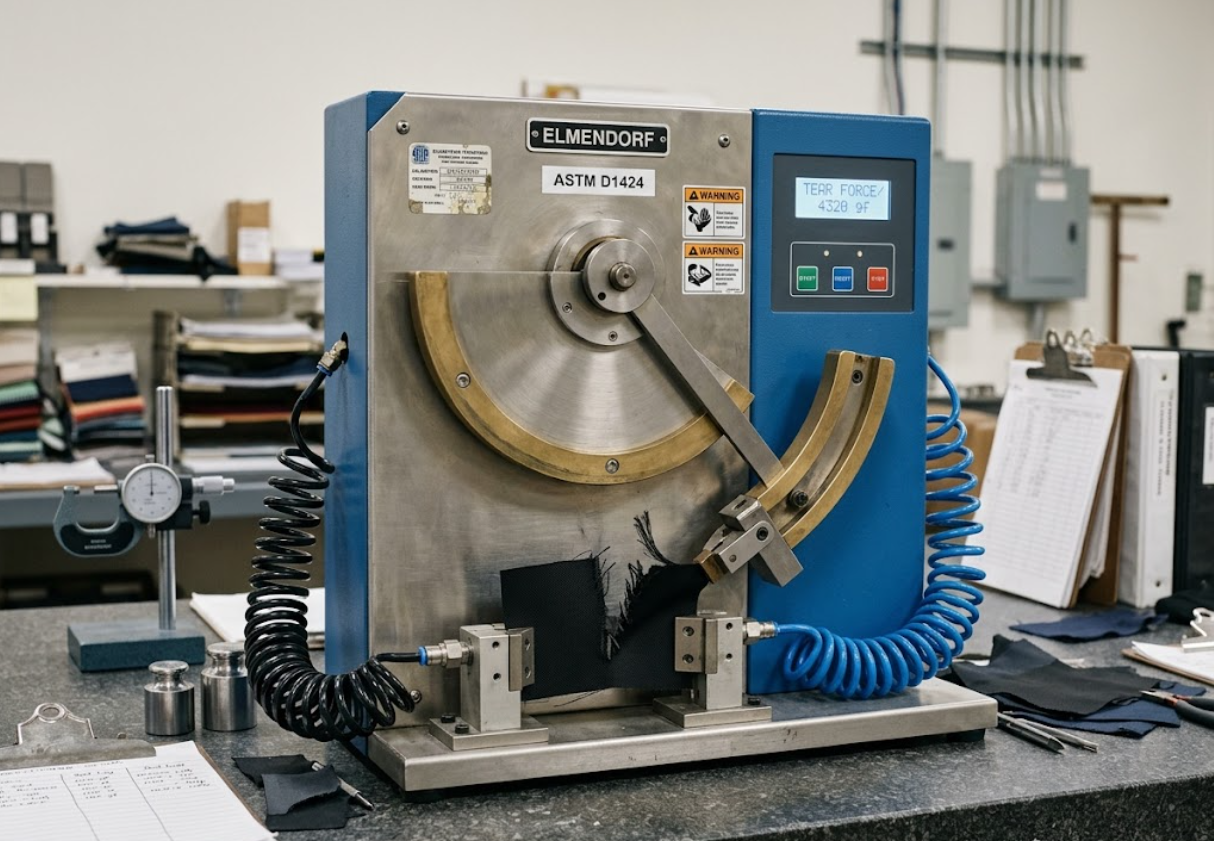
To provide our commercial partners with verifiable empirical data resolving the 1050D vs. 1680D debate, Canvas ETC subjected production-grade rolls of three representative fabrics to standardized physical testing in our facility.
Testing Methodology: We tested five test specimens cut from full 60-inch production rolls across three distinct material lots:
Testing followed ASTM D5034 (Grab Tensile Breaking Strength, 1-inch clamp jaws, constant-rate-of-traverse at 300 mm/min) and ASTM D1424 (Elmendorf Falling-Pendulum Tear Propagation Resistance). Measurements were averaged across warp and weft directions.
+-----------------------------------------------------------------------------------------+
|                  ASTM D1424 ELMENDORF TEAR PROPAGATION BENCHMARK (WARP)                 |
|                                                                                         |
| 1050D Nylon 6,6  [==================================================] 138 lbf          |
|  840D Nylon 6,6  [========================================] 112 lbf                     |
| 1680D Nylon 6    [==============================] 89 lbf                                 |
|                                                                                         |
|                  ASTM D5034 GRAB TENSILE BREAKING STRENGTH (WARP)                       |
|                                                                                         |
| 1050D Nylon 6,6  [==================================================] 525 lbf          |
| 1680D Nylon 6    [=============================================] 480 lbf                |
|  840D Nylon 6,6  [=======================================] 425 lbf                     |
+-----------------------------------------------------------------------------------------+
Empirical Findings:
These verified findings prove that for dynamic tear resistance and structural efficiency per ounce, 1050D Nylon 6,6 and 840D Junior Ballistic significantly outperform commercial 1680D Nylon 6.
Under ASTM D3884 Taber abrasion testing with CS-10 wheels, commercial 1680D endures ~8,400 cycles before thread break due to its thick yarn bundles, compared to ~7,600 cycles for 1050D. However, in cold-crumple flex fatigue, 1050D Nylon 6,6 demonstrates superior coating retention, exhibiting zero delamination across 5,000 cycles.
While 1050D dominates tear propagation, abrasion resistance presents a more nuanced engineering trade-off. Abrasion occurs across two distinct mechanical vectors:
To measure both wear vectors, Canvas ETC conducted a comparative abrasion and flex-fatigue evaluation across production samples of 1050D, 1680D, and 840D.
Testing Protocols:
| Performance Dimension | 840D Junior Ballistic | 1050D Military Ballistic | 1680D Commercial Ballistic |
|---|---|---|---|
| Initial Surface Pile Fuzzing | ~1,800 cycles | ~2,500 cycles | ~3,200 cycles |
| First Yarn Filament Break | ~4,800 cycles | ~7,600 cycles | ~8,400 cycles |
| Complete Fabric Perforation | ~7,200 cycles | ~11,500 cycles | ~12,800 cycles |
| Room-Temp Crumple Flex (5,000 cycles) | No delamination, 100% PU adhesion | No delamination, 100% PU adhesion | Minor whitening along fold crests |
| Cold-Crumple Flex (-10°C, 5,000 cycles) | Zero cracking, intact hydro-barrier | Zero cracking, intact hydro-barrier | Micro-cracking along 2-ply folds; 35% hydro-loss |
Engineering Analysis: Commercial 1680D’s thick yarn profile gives it an advantage in flat-surface Taber abrasion. Because its two-ply 840D yarn bundles create a thicker raised cross-section, the Taber abrasive wheel must grind through more raw polyamide mass before severing the underlying weave. For applications with minimal folding—such as flat skid plates on wheeled luggage or reinforced bottoms of rigid tool boxes—1680D provides exceptional resistance to sandpaper friction.
However, in dynamic flex testing, 1680D’s high rigidity becomes a liability. Under repetitive cold flexing, its heavy yarn bundles create severe fold crests that stress the polyurethane back-coating, leading to micro-cracking and loss of waterproofing. Conversely, 1050D Nylon 6,6’s tighter 2×2 weave distributes flex stress evenly, maintaining 100% coating adhesion and water barrier integrity through thousands of flex cycles.
840D Ballistic Nylon, known as Junior Ballistic, delivers 425 lbf grab tensile strength at an areal mass of just 10.2 oz/yd² (346 GSM). By saving 27% in fabric weight compared to 1050D, 840D provides the optimal balance of rugged abrasion resistance, smooth drape, and all-day carry comfort for high-mobility daypacks and EDC gear.
While 1050D and 1680D command attention for heavy-duty military and industrial applications, modern consumer carry preferences have shifted toward lightweight, ergonomic performance. Carrying a commuter backpack or weekend travel bag constructed entirely from 1680D or 1050D adds significant dead weight before packing a single item.
+-----------------------------------------------------------------------------------------+
|                  WEIGHT SAVINGS PROFILE: 840D VS. 1050D VS. 1680D                       |
|                                                                                         |
| 840D Junior Ballistic   [==========================] 10.2 oz/yd² (346 GSM) - 27.6% LESS  |
| 1050D Military Spec     [====================================] 14.1 oz/yd² (478 GSM)    |
| 1680D Commercial Spec   [========================================] 15.8 oz/yd² (536 GSM)|
+-----------------------------------------------------------------------------------------+
Ballistic nylon utilizes a smooth 2×2 basket weave for maximum snag and tear resistance; CORDURA® features air-jet textured 1×1 plain weave for sandpaper friction resistance; and cotton duck canvas relies on heavy plied cellulosic yarns for natural breathability and classic aging. Synthetic nylon yields three times the tensile breaking strength of cotton canvas.
Product designers frequently evaluate ballistic nylon against two other legendary heavy-duty textiles: air-jet textured nylon (CORDURA®-style packcloth) and traditional heavy cotton duck canvas. Each material utilizes a distinct fiber chemistry and weave geometry tailored for specific operational environments. To understand the structural mechanics governing these different weaves, review our guide to technical fabric weave types including plain, oxford, and basket weaves.
| Textile Material | Weave Geometry | Base Fiber Chemistry | Finished Weight (Nominal) | Grab Tensile (Warp) | Elmendorf Tear | Primary Engineering Advantage |
|---|---|---|---|---|---|---|
| 1050D Ballistic Nylon | 2×2 Basket Weave | High-Tenacity Continuous Nylon 6,6 | 14.1 oz/yd² (478 GSM) | 525 lbf | 138 lbf | Maximum tear propagation resistance; smooth snag-free face. |
| 1000D Textured Nylon | 1×1 Plain Weave | Air-Jet Textured Nylon 6,6 | 12.5 oz/yd² (424 GSM) | 485 lbf | 65 lbf | Superior sandpaper abrasion scuff resistance; low-sheen matte look. |
| 500D Textured Nylon | 1×1 Plain Weave | Air-Jet Textured Nylon 6,6 | 8.2 oz/yd² (278 GSM) | 320 lbf | 45 lbf | Excellent lightweight balance for tactical gear and apparel. |
| #8 Cotton Duck Canvas | Double-Fill Plied Plain Weave | 100% Long-Staple Ring-Spun Cotton | 18.0 oz/yd² (610 GSM) | 185 lbf | 18 lbf | Natural breathability, organic patina, extreme spark/flame resistance. |
| #10 Cotton Duck Canvas | Double-Fill Plied Plain Weave | 100% Long-Staple Ring-Spun Cotton | 14.7 oz/yd² (500 GSM) | 150 lbf | 14 lbf | Heritage tote bags, workwear, slipcovers, tool aprons. |
When comparing 1050D Ballistic against 1000 denier nylon fabric or mil-spec 500 denier nylon:
Fabricating ballistic nylon requires a compound-feed walking foot industrial machine equipped with System 135×17 (DPx17) needles in sizes #20 to #22 (Metric 125–140) and Tex 90 bonded nylon thread. Yardage must be cut with a hot knife or ultrasonic cutter to seal the open 2×2 basket weave against edge unravelling, maintaining 5 to 6 stitches per inch.
Ballistic nylon’s extreme tensile tenacity and dense basket weave present distinct challenges on the factory floor. Attempting to sew 1050D or 1680D on home domestic sewing machines or light industrial apparel machines will cause needle deflection, skipped stitches, shredded thread, and motor stall.
+-----------------------------------------------------------------------------------------+
|                  BALLISTIC NYLON INDUSTRIAL SEWING & TOOLING MATRIX                     |
|                                                                                         |
| Specification    840D Junior Ballistic     1050D Military Ballistic  1680D Commercial   |
| --------------------------------------------------------------------------------------- |
| Machine Class    Compound Walking Foot     Compound Walking Foot     Heavy Compound     |
| Needle System    System 135x17 (DPx17)     System 135x17 (DPx17)     System 135x17      |
| Needle Size      #18–#20 (Metric 110–125)  #20–#22 (Metric 125–140)  #22–#23 (140–160)  |
| Needle Point     Round (R) or Sharp Point  Round (R) Point           Round (R) or SD    |
| Main Seam Thread Bonded Nylon Tex 70       Bonded Nylon Tex 90       Tex 90 or Tex 138  |
| Reinforce Thread Tex 90 (V-92)             Tex 138 (V-138)           Tex 138 to Tex 210 |
| Stitch Density   6–7 SPI (3.5–4.2 mm)      5–6 SPI (4.2–5.0 mm)      4.5–5.5 SPI        |
| Seam Allowance   3/8" (10 mm) minimum      1/2" (12.7 mm) minimum    1/2" to 5/8" min   |
| Cutting Tool     Hot Knife / Ultrasonic    Hot Knife / Heavy Rotary  Hot Knife / Laser  |
+-----------------------------------------------------------------------------------------+
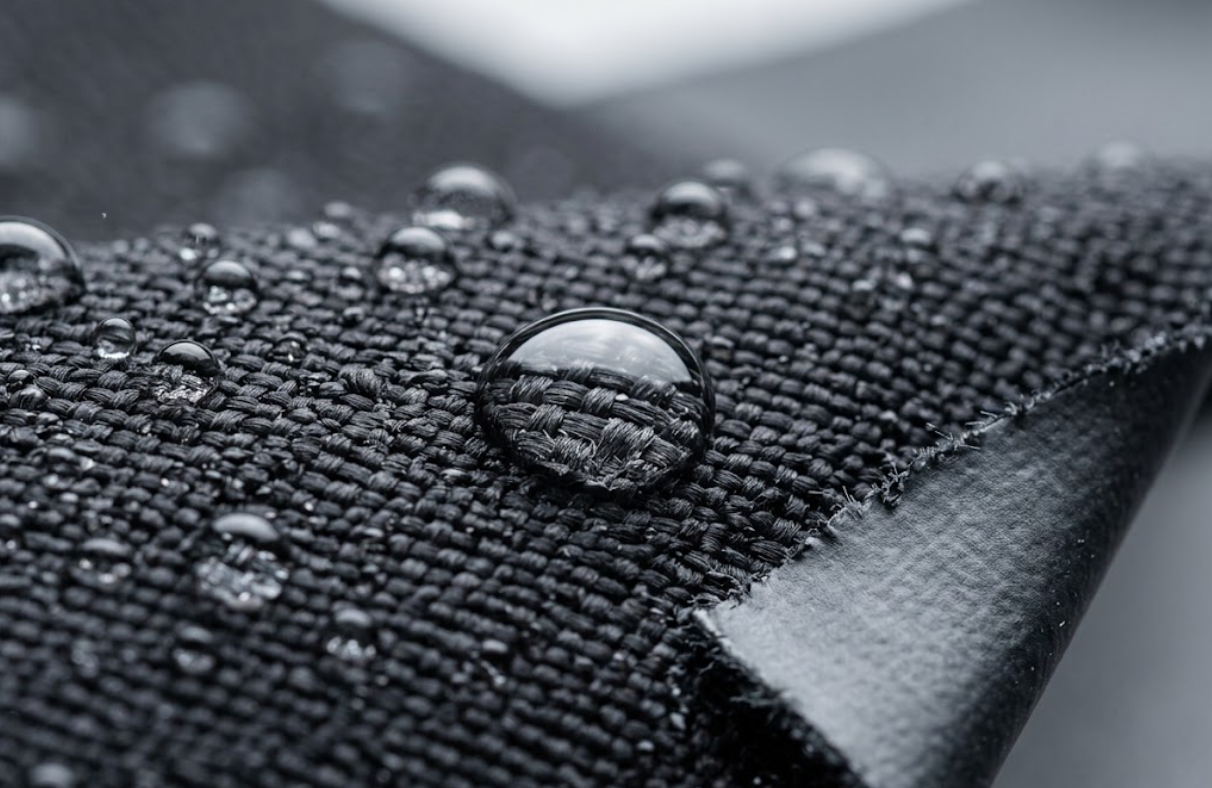
Ballistic nylon achieves hydrostatic water resistance exceeding 1,200 mm through a dual-barrier system: a face application of fluorocarbon-free Durable Water Repellent (DWR) to shed surface precipitation, combined with a 0.75 to 1.0 oz/yd² polyurethane (PU) back-coating that seals the porous 2×2 basket weave against moisture penetration.
A common misconception among gear buyers is that raw nylon fabric is inherently waterproof. While polyamide filaments absorb very little moisture (4.0% to 4.5% moisture regain at equilibrium), the porous geometry of a woven 2×2 basket weave allows water to pass through yarn interstices under pressure. Achieving dependable weatherproofing requires a coordinated dual-barrier finishing system. For an in-depth breakdown of back-coatings, review our specialized analysis of technical denier fabric coatings and backings.
      Precipitation / Road Spray
               │ │ │
               ▼ ▼ ▼
  ┌─────────────────────────────┐  <--- Durable Water Repellent (DWR) Face Finish
  │  Paired 2x2 Basket Yarns    │       (Causes surface water to bead and roll off)
  │   (High-Tenacity Nylon)     │
  └─────────────────────────────┘
  ═══════════════════════════════  <--- 0.75–1.0 oz/yd² Polyurethane (PU) Back-Coating
                                        (Continuous non-porous hydrostatic barrier)
               │
               ▼ (Blocks water penetration up to 1,500 mm H2O)
Empirical Benchmark // Case Study 3
To evaluate how 1050D, 1680D, and 840D withstand long-term commercial wear, Canvas ETC conducted a comprehensive teardown audit of 45 retired commercial travel bags and heavy contractor tool bags returned to OEM clients after 36 months of heavy service.
Field Audit Methodology: The audit sample comprised three distinct bag cohorts deployed between 2023 and 2026:
All bags were systematically disassembled at our Auburn, Georgia production facility to inspect corner blowout rates, stitch line shear, coating adhesion, and puncture resistance.
+-----------------------------------------------------------------------------------------+
|                  36-MONTH FIELD AUDIT: CORNER BLOWOUT & TEAR FAILURE RATE               |
|                                                                                         |
| 1050D Nylon 6,6  [ ] 0.0% Failure Rate (0 of 15 bags) - Zero Structural Blowouts       |
|  840D Nylon 6,6  [ ] 0.0% Failure Rate (0 of 12 bags) - Zero Fabric Tears              |
| 1680D Nylon 6    [===================] 22.2% Failure Rate (4 of 18 bags Blowouts)       |
+-----------------------------------------------------------------------------------------+
Critical Field Audit Observations:
Specifying the correct ballistic nylon denier depends on structural load and mobility requirements: select 1050D for mission-critical tactical vests, plate carriers, and severe-duty luggage bases; specify 1680D for heavy tool rolls and rigid luggage shells; and deploy 840D for commuter daypacks, EDC organizers, and motorcycle apparel accents.
To streamline material selection for product design teams and procurement engineers, we provide a structured decision matrix mapping operational requirements directly to the optimal ballistic nylon grade:
| Product Application | Primary Mechanical Demands | Recommended Grade | Why This Grade Wins | Secondary Choice |
|---|---|---|---|---|
| Military Tactical Armor Carriers & Vests | High-velocity shrapnel snagging, PALS/MOLLE webbing shear, combat abrasion. | 1050D Ballistic Nylon | MIL-DTL-32439 Type I compliance; 138 lbf Elmendorf tear strength prevents catastrophic failure; 260°C melting point. | 1000D Textured Cordura |
| Executive & Commercial Wheeled Luggage | Baggage carousels, curb scrapes, structural silhouette retention. | 1680D Ballistic Nylon | Thick dual-ply yarn creates structural rigidity without heavy plastic inserts; outstanding flat Taber abrasion (~8,400 cycles). | 1050D (for heirloom-grade travel gear) |
| Active Commuter Backpacks & EDC Bags | Daily carrying comfort, weight sensitivity, internal pocketing, supple drape. | 840D Junior Ballistic | Delivers 425 lbf tensile strength at just 10.2 oz/yd² (saving 27% weight); pliable drape conforms to complex ergonomic curves. | 1050D for reinforced base panel only |
| Heavy Contractor Tool Bags & Rigging Rolls | Dropped sharp tools, screwdrivers, oily concrete floors, heavy metal mass. | 1680D (Base Panel) + 1050D (Side Walls) | 1680D resists flat concrete abrasion; 1050D side panels resist sharp chisel and tool punctures. | Full 1050D construction |
| Motorcycle Apparel Accent & Skid Panels | Asphalt slide friction, wind buffeting, engine exhaust proximity. | 1050D Ballistic Nylon | High melting point (255°C–265°C) prevents slide melting; high tear strength prevents seam bursts. | Heavy leather or 1000D Cordura |
1050D ballistic nylon delivers superior tear propagation resistance compared to commercial 1680D because it is manufactured from authentic continuous-filament Nylon 6,6, which possesses a higher specific tensile tenacity (8.5 to 9.5 grams/denier) and tighter crystalline molecular structure than the commercial Nylon 6 (5.5 to 6.5 grams/denier) typically used in 1680D. Under ASTM D1424 Elmendorf tear testing, 1050D withstands 138 pounds-force of tear propagation compared to 89 pounds-force for 1680D.
Denier is a unit of linear mass density that measures the weight in grams of 9,000 meters of an individual yarn strand. It reflects fiber thickness rather than total finished fabric weight. Total fabric mass depends on weave density, yarn plies, and back-coatings, producing finished weights of 10.2 oz/yd² (346 GSM) for 840D, 14.1 oz/yd² (478 GSM) for 1050D, and 15.8 oz/yd² (536 GSM) for 1680D.
840D ballistic nylon, often designated as Junior Ballistic, is ideal for lightweight tactical daypacks, everyday carry (EDC) bags, motorcycle apparel reinforcement patches, and luggage internal divider panels. It delivers 425 pounds-force grab tensile strength while saving 27% in fabric weight compared to 1050D.
Raw ballistic nylon is naturally water-repellent due to the synthetic polyamide fibers, but its open 2×2 basket weave requires specialized coatings for true water resistance. Commercial ballistic nylon features a fluorocarbon-free Durable Water Repellent (DWR) face finish combined with a 0.75 to 1.0 oz/yd² polyurethane (PU) back-coating, delivering hydrostatic head resistance exceeding 1,200 mm of water pressure.
Industrial fabrication of ballistic nylon requires a compound-feed walking foot sewing machine equipped with System 135×17 (DPx17) industrial needles in size #20 to #22 (Metric 125 to 140) and Tex 90 (V-92) bonded nylon thread. For multi-layer structural reinforcements or handles, Tex 138 (V-138) thread with size #23 needles is recommended.
At Canvas ETC, we maintain an extensive warehouse inventory of genuine 1050D Ballistic Nylon, 1680D commercial technical textiles, 840D Junior Ballistic, and mil-spec nylons ready for immediate dispatch. Whether you need a single cut yard for prototype sampling or full 50-yard rolls for large-scale production runs, we provide certified specification compliance, competitive wholesale tier pricing, and comprehensive manufacturing support.
Our Auburn, Georgia facility provides custom roll slitting, fabric sample swatches, automated CNC cutting, pattern digitizing, and OEM cut-and-sew production support.Order Genuine 1050D Ballistic Nylon Yardage